Acute Bladder Snail
Physella acuta (Draparnaud, 1805)
Names
| English | Acute Bladder Snail |
|---|---|
| Dutch | Puntige blaashoren |
| Spanish | Caracol de vejiga afilada |
| Chinese | 尖小膀胱螺 |
| Scientific name | Physella acuta (Draparnaud, 1805) |
About this species
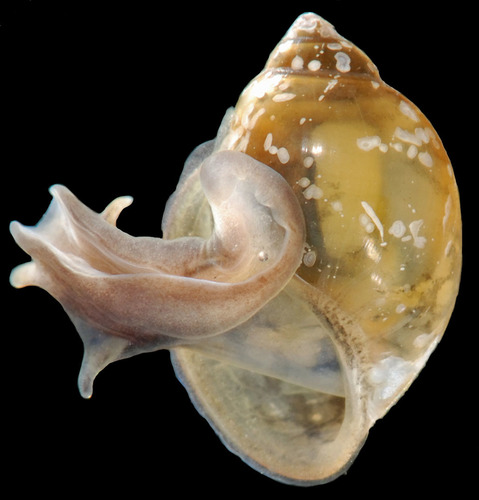
Physella acuta, also known as the European physa, tadpole snail, sewage snail, bladder snail, or acute bladder snail, is a species of small, air-breathing freshwater snail of the family Physidae. It originates from North America and was first described in 1805 by Jacques Philippe Raymond Draparnaud based on a specimen found in France. Like other physids, P. acuta presents a sinistral (left-coiling) shell as well as a unique set of muscles called the physid musculature that allows it to rapidly twist the shell as a defence mechanism.
P. acuta is invasive on all continents except Antarctica and is considered by Dillon and colleagues (2002) as "the world's most cosmopolitan freshwater gastropod". Its first introduction outside North America likely occurred through the 18th-century cotton trade to Europe, while later spread mainly happened through the aquarium trade. The species can occupy diverse freshwater habitats and tolerates polluted as well as oxygen-poor environments. It can reproduce with other individuals and also self-fertilise.
Read more on Wikipedia · Text: Wikipedia, CC BY-SA 4.0
Physella acuta es un caracol de agua dulce es una especie de familia Physidae.[1]
Seguir leyendo en Wikipedia · Texto: Wikipedia, CC BY-SA 4.0
尖膀胱螺(学名:Physella acuta),又名尖囊螺、小泡螺,属膀胱螺科小膀胱螺属,是膀胱螺科下的一种小型、用肺呼吸的淡水螺。该物种原产于北美洲,1805年由雅克·德拉帕诺根据在法国发现的标本首次进行了描述。与其他膀胱螺科物种一样,尖膀胱螺拥有独特的左旋(逆时针旋转)外壳,并具备一组特殊的“膀胱螺肌群”,使其能够通过快速扭动外壳来防御天敌。
尖膀胱螺的足迹已遍布除南极洲以外的所有大陆,是一种入侵物种,被誉为“全球分布最广的淡水腹足动物”。该物种首次传出北美,很可能是通过18世纪对欧洲的棉花贸易;此后的扩散则主要源于水族贸易。
尖膀胱螺能适应各种淡水生境,对污染和缺氧环境也有极高的耐受性。它们既能异体交配,也可以孤雌生殖(异体受精与自体受精皆可)。凭借高繁殖率以及对劣质栖息地的强适应能力,它们常常在竞争中压制本土螺类。
虽然在入侵的尖膀胱螺群体中的寄生率通常较低,但科学家于2024年在巴西里约热内卢的一份样本中发现到了能引发人类消化道疾病(棘口吸虫病)的棘口吸虫。
在水族箱中,尖膀胱螺通常随观赏植物被无意引入。由于繁殖迅速,它们常被视为“害螺”。然而,如果能将数量控制在合理范围内,它们其实有助于清理有机残渣并抑制藻类爆发。
在维基百科上阅读更多 · 文字:维基百科,CC BY-SA 4.0
Classification
| Kingdom | Animalia |
|---|---|
| Phylum | Mollusca |
| Class | Gastropoda |
| Family | Physidae |
| Genus | Physella |