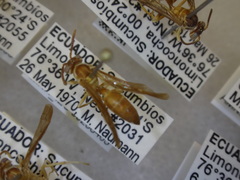
Angiopolybia pallens
Names
| English | — |
|---|---|
| Dutch | — |
| Spanish | Avispa de embudo pálida |
| Chinese | — |
| Sranan Tongo | waswasi (general name for the group) |
| Scientific name | Angiopolybia pallens (Lepeletier, 1836) |
About this species
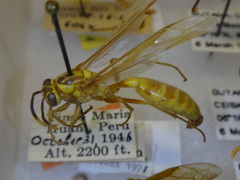
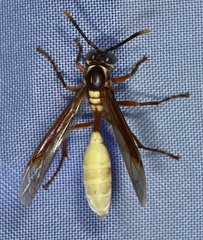
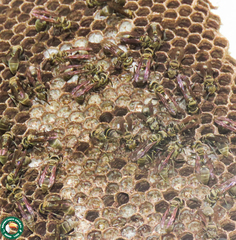
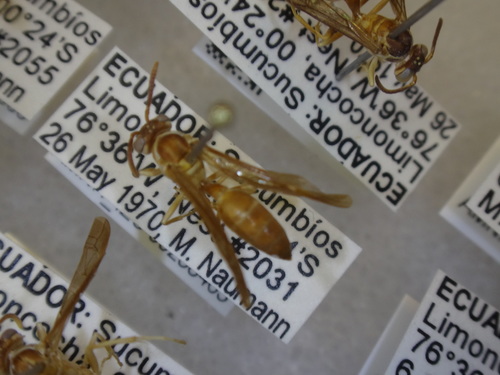
Angiopolybia pallens is a species of social wasp predominantly found in South America. The wasp is generally seen in Brazilian rainforests. This species was discovered by Lepeletier in 1836. It typically feeds on nectar and carrion. In fact much of its feeding behavior and impact on humans is centered on feeding on animal carcasses. The wasp species displays a caste differentiation that can be seen by difference in ovarian development. Additionally they have a unique colony establishment procedure. It begins with a few individuals from the nest leaving to find a good site and then the rest of the colony follows using specific communication signals that are further discussed in this article.
Read more on Wikipedia · Text: Wikipedia, CC BY-SA 4.0
Classification
| Kingdom | Animalia |
|---|---|
| Phylum | Arthropoda |
| Class | Insecta |
| Order | Hymenoptera |
| Family | Vespidae |
| Genus | Angiopolybia |