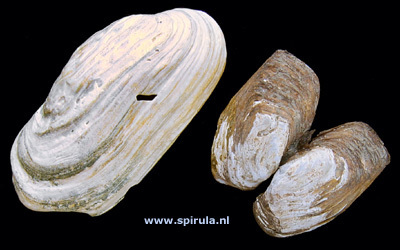
Arctic Hiatella
Hiatella arctica (Linnaeus, 1767)
Names
| English | Arctic Hiatella |
|---|---|
| Dutch | Noordse rotsboorder |
| Spanish | — |
| Chinese | 北极缝栖蛤 |
| Scientific name | Hiatella arctica (Linnaeus, 1767) |
About this species
Hiatella arctica, known as the wrinkled rock-borer, the arctic hiatella or the arctic saxicave, is a species of saltwater clam, a marine bivalve mollusc in the family Hiatellidae. The white shell of this mollusc is thick and more or less rectangular, but generally irregular in shape. It is up to 45 mm (1.8 in) long.
Hiatella arctica is widespread and found in all the oceans, ranging from the Arctic and Antarctic to the subtropical and tropical zones. It occurs from the low water mark to depths of down to 800 m (2,600 ft). It lives on hard substrates, often attached with byssus, for instance in mussel beds or nestling among kelp holdfasts, or hiding in rock crevices and also boring itself into soft rocks.
Read more on Wikipedia · Text: Wikipedia, CC BY-SA 4.0
Hiatella arctica es una especie de molusco bivalvo marino perteneciente a la familia Hiatellidae que habita en el océano Ártico, así como en Nueva Zelanda, las islas Chatham y Macquerie (Australia). Vive en el intermareal hasta una profundidad de 180 m por debajo del nivel del mar.
Seguir leyendo en Wikipedia · Texto: Wikipedia, CC BY-SA 4.0
Classification
| Kingdom | Animalia |
|---|---|
| Phylum | Mollusca |
| Class | Bivalvia |
| Order | Adapedonta |
| Family | Hiatellidae |
| Genus | Hiatella |