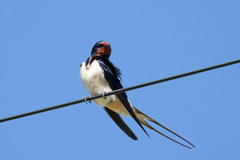
Songbirds & other perching birds
Barn Swallow
Hirundo rustica Linnaeus, 1758
Names
| English | Barn Swallow |
|---|---|
| Dutch | Boerenzwaluw |
| Spanish | Golondrina tijereta |
| Chinese | 家燕 |
| Scientific name | Hirundo rustica Linnaeus, 1758 |
About this species
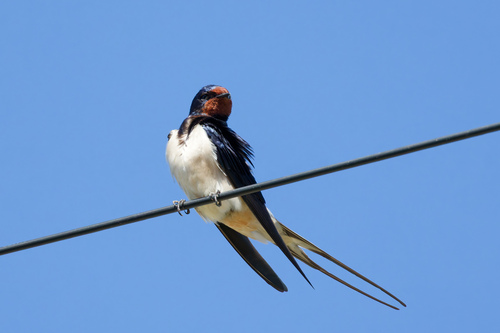
The barn swallow (Hirundo rustica) is the most widespread species of swallow in the world, occurring on all continents, with vagrants reported even in Antarctica. It is a distinctive passerine bird with blue upperparts and a long, deeply forked tail. In Anglophone Europe, it is just called the swallow; in northern Europe, it is the only member of family Hirundinidae called a "swallow" rather than a "martin".
There are eight subspecies of barn swallow, which breed across the Northern Hemisphere. Two subspecies (H. r. savignii and H. r. transitiva) have fairly restricted ranges in the Nile valley and eastern Mediterranean, respectively. The other six are more widespread, with winter ranges covering much of the Southern Hemisphere.
The barn swallow is a bird of open country that normally nests in man-made structures and consequently has spread with human expansion. It builds a cup nest from mud pellets in barns or similar structures and feeds on insects caught in flight.
Read more on Wikipedia · Text: Wikipedia, CC BY-SA 4.0
La golondrina común (Hirundo rustica) es una especie de ave paseriforme de la familia Hirundinidae de hábitos migratorios. Se trata de la golondrina con la mayor área de distribución del mundo. Habita en Europa, Asia, África, América y parte de Australasia.
Existen seis subespecies de golondrina común, que se reproducen a lo largo del hemisferio norte. Cuatro de ellas son fuertemente migratorias y sus cuarteles de invernada cubren gran parte del hemisferio sur, llegando a Argentina central, Sudáfrica y el norte de Australia. Su vasta área de distribución y enorme población implican que la especie se encuentra fuera de peligro de extinción, aunque pueda haber decrecimientos poblacionales locales debido a amenazas específicas.
La golondrina común es un ave de campo abierto que normalmente utiliza estructuras construidas por el ser humano para reproducirse y que, en consecuencia, se ha diseminado con la expansión humana. Construye nidos en forma de taza, con bolitas de barro en graneros y construcciones similares, y se alimenta de insectos que atrapa en vuelo.
Seguir leyendo en Wikipedia · Texto: Wikipedia, CC BY-SA 4.0
家燕(学名:Hirundo rustica),又名越燕(《本草经集注》)、汉燕(《酉阳杂俎》)、紫燕(《尔雅翼》)、乌燕(《田家五行》)、拙燕(《盛京通志》),是燕科燕属的一种鸟类,是全球分布最广泛的燕类,出现在所有大陆,主要是候鸟,繁殖于全北界,过冬于新、旧热带界和东洋界,在南极洲有迷鸟记录。
家燕是一种外形独特的雀形目鸟类,具有蓝色的上半身和长而深深分叉的尾巴。在英语世界的欧洲地区,家燕通常仅称为swallow;而在北欧,它是唯一被称为“swallow”而非“martin”的燕科成员。
家燕共有六个亚种,分布于北半球各地繁殖。 其中两个亚种(H. r. savignii 和 H. r. transitiva)分别局限于尼罗河谷和地中海东部。 其余四个亚种分布更广泛,冬季迁徙范围涵盖南半球的大部分地区。
家燕主要栖息于开阔地带,通常在人工建筑物中筑巢,因此随着人类的扩展而扩散。它们利用泥球筑巢,通常位于谷仓或类似建筑物中,并在空中捕食昆虫。 家燕与人类有密切的共生关系,它们捕食昆虫的习性使得人类对其颇为包容;过去关于家燕和其巢穴的迷信更强化了这种接受度。由于家燕与人类的生活环境接近且每年迁徙,因此在文学和宗教作品中经常出现与家燕相关的文化符号。家燕是奥地利和爱沙尼亚的国鸟。
在维基百科上阅读更多 · 文字:维基百科,CC BY-SA 4.0
Classification
| Kingdom | Animalia |
|---|---|
| Phylum | Chordata |
| Class | Aves |
| Order | Passeriformes |
| Family | Hirundinidae |
| Genus | Hirundo |
In Suriname
Where it has been recorded
- Nickerie88
- Sipaliwini74
- Paramaribo62
- Commewijne58
- Para36
- Wanica6
- Marowijne6
- Brokopondo5
- Coronie3
- Saramacca3
Districts with at least one record that has coordinates. Shaded districts have records.
Records by month
All years combined.