Big Brown Bat
Eptesicus fuscus (Palisot de Beauvois, 1796)
Names
| English | Big Brown Bat |
|---|---|
| Dutch | Grote Bruine Vleermuis |
| Spanish | Murciélago moreno |
| Chinese | 大棕蝠 |
| Scientific name | Eptesicus fuscus (Palisot de Beauvois, 1796) |
About this species
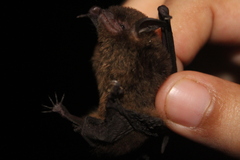
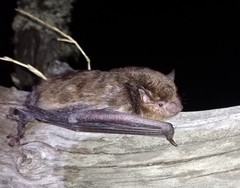
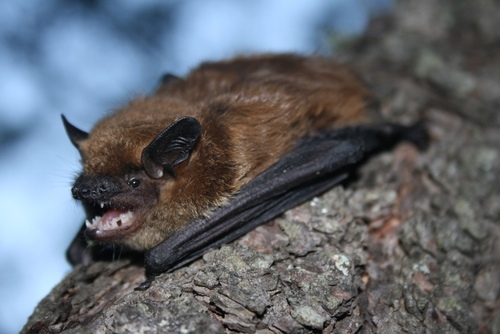
The big brown bat (Eptesicus fuscus) is a species of vesper bat distributed widely throughout North America, the Caribbean, and the northern portion of South America. It was first described as a species in 1796. Compared to other microbats, the big brown bat is relatively large, weighing 15–26 g (0.53–0.92 oz) and possessing a wingspan of 32.5–35 cm (12.8–13.8 in).
Big brown bats are insectivorous, consuming a diverse array of insects, particularly night-flying insects, but especially beetles. Some of the beetles it consumes are serious agricultural pests, including cucumber beetles. They are nocturnal, foraging for prey at night and roosting in sheltered areas during the day such as caves, tunnels, tree cavities, and human structures. Their breeding season is in the fall, shortly before their annual hibernation. After hibernation ends in the spring, females form maternity colonies for giving birth to young. Oftentimes only one offspring is produced per litter, though twins are common in the Eastern US. Lifespans of 6.5 years are considered average.
Read more on Wikipedia · Text: Wikipedia, CC BY-SA 4.0
El murciélago moreno (Eptesicus fuscus) es una especie de quiróptero que habita desde el sur de Canadá hasta Colombia y el norte de Sudamérica y en las Antillas, a menos de 2.700 m de altitud. Es muy frecuente en los asentamientos humanos.
Seguir leyendo en Wikipedia · Texto: Wikipedia, CC BY-SA 4.0
Classification
| Kingdom | Animalia |
|---|---|
| Phylum | Chordata |
| Class | Mammalia |
| Order | Chiroptera |
| Family | Vespertilionidae |
| Genus | Eptesicus |