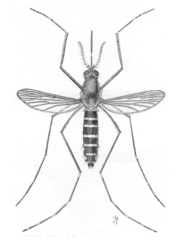
Black Saltmarsh Mosquito
Aedes taeniorhynchus (Wiedemann, 1821)
Names
| English | Black Saltmarsh Mosquito |
|---|---|
| Dutch | — |
| Spanish | — |
| Chinese | — |
| Sranan Tongo | maskita (general name for the group) |
| Scientific name | Aedes taeniorhynchus (Wiedemann, 1821) |
About this species
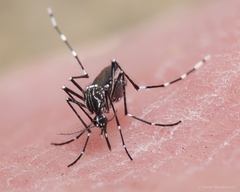
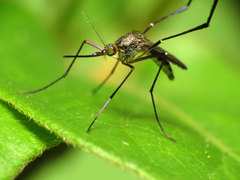
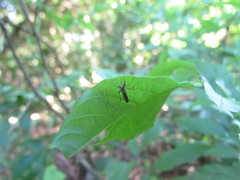
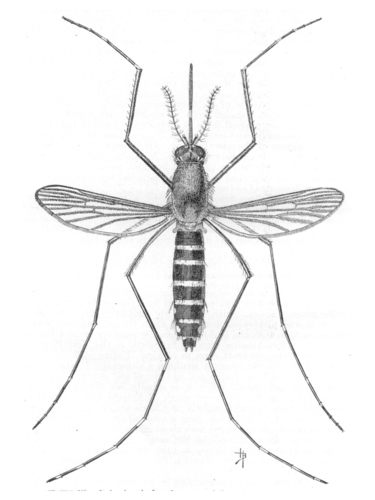
Aedes taeniorhynchus, or the black salt marsh mosquito, is a mosquito in the family Culicidae. It is a carrier for encephalitic viruses including Venezuelan equine encephalitis and can transmit Dirofilaria immitis. It resides in the Americas and is known to bite mammals, reptiles, and birds. Like other mosquitoes, Ae. taeniorhynchus adults survive on a combination diet of blood and sugar, with females generally requiring a blood meal before laying eggs.
This mosquito has been studied to investigate its development, physiological markers, and behavioral patterns, including periodic cycles for biting, flight, and swarming. This species is noted for developing in periodic cycles, with high sensitivity to light and flight patterns that result in specific wingbeat frequencies that allow for both species detection and sex distinction.
Ae. taeniorhynchus is known to be a pest to humans and mechanisms for controlling Ae. taeniorhynchus populations have been developed. The United States has spent millions of dollars to control and contain Ae. taeniorhynchus.
Read more on Wikipedia · Text: Wikipedia, CC BY-SA 4.0
Aedes taeniorhynchus is een muggensoort uit de familie van de steekmuggen (Culicidae). De wetenschappelijke naam van de soort is voor het eerst geldig gepubliceerd in 1821 door Wiedemann.
Lees verder op Wikipedia · Tekst: Wikipedia, CC BY-SA 4.0
Aedes taeniorhynchus, o el mosquito negro de las marismas es un mosquito de la familia Culicidae. Es portador del virus encefalíticos, incluida la encefalitis equina venezolana y transmite la Dirofilaria immitis. Reside en América y es conocido por picar mamíferos, reptiles y aves. Como otros mosquitos, Aedes taeniorhynchus. Los adultos de taeniorhynchus sobreviven con una dieta combinada de sangre y azúcar, y las hembras generalmente requieren una ingestión de sangre antes de poner huevos.
Este mosquito ha sido estudiado para investigar su desarrollo, marcadores fisiológicos y patrones de comportamiento, incluidos los ciclos periódicos de picadura, vuelo y enjambre. Esta especie se caracteriza por desarrollarse en ciclos periódicos, con alta sensibilidad a la luz y los patrones de vuelo que dan como resultado frecuencias específicas de aleteo que permiten tanto la detección de especies como la distinción de sexos.
Aedes taeniorhynchus es conocido por ser una plaga para los humanos y los mecanismos para controlar Ae. Se han desarrollado poblaciones de taeniorhynchus.
Seguir leyendo en Wikipedia · Texto: Wikipedia, CC BY-SA 4.0
Classification
| Kingdom | Animalia |
|---|---|
| Phylum | Arthropoda |
| Class | Insecta |
| Order | Diptera |
| Family | Culicidae |
| Genus | Aedes |
In Suriname
Where it has been recorded
- Para18
- Wanica2
- Marowijne1
- Paramaribo1
Districts with at least one record that has coordinates. Shaded districts have records.
Records by month
All years combined.