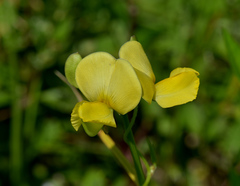
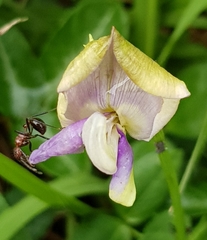
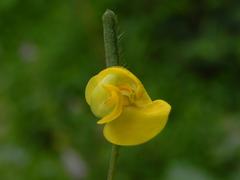
Blackeyed pea
Vigna unguiculata (L.) Walp.
Names
| English | Blackeyed pea |
|---|---|
| Dutch | — |
| Spanish | — |
| Chinese | 豇豆 |
| Scientific name | Vigna unguiculata (L.) Walp. |
About this species
The cowpea (Vigna unguiculata) is an annual herbaceous legume from the genus Vigna. It can be erect, semierect (trailing), or climbing. A high level of morphological diversity is found within the species with large variations in the size, shape, and structure of the plant. Four subspecies are recognised, three of which are cultivated.
Its tolerance for sandy soil and low rainfall have made it an important crop in the semiarid regions across Africa and Asia. It was domesticated in Africa and is one of the oldest crops to be farmed. A second domestication event probably occurred in Asia, before they spread into Europe and the Americas.
Most cowpeas are grown on the African continent, particularly in Nigeria and Niger, which account for 66% of world production. A 1997 estimate suggests that cowpeas are cultivated on 12.5 million hectares (31 million acres) of land, have a worldwide production of 3 million tonnes and are consumed by 200 million people on a daily basis. Insect infestation is a major constraint to the production of cowpea, sometimes causing over 90% loss in yield.
Read more on Wikipedia · Text: Wikipedia, CC BY-SA 4.0
Vigna unguiculata is een plantensoort uit de vlinderbloemenfamilie.
Lees verder op Wikipedia · Tekst: Wikipedia, CC BY-SA 4.0
Vigna unguiculata, comúnmente llamado caupí, carilla, alubia ojo de perdiz, judía de careta, frijol de carita, frejol Castilla (Perú), frijol paciencia (Ecuador), chíchere, chíchare, chicharillo, chícharo salvaje, frijol chino, frijol cabecita negra, poroto tape (Uruguay), chícharo de boquita negra (Sevilla), espelón o xpelón (Yucatán), anconí (Provincia de San Juan (República Dominicana)), es una legumbre comestible de la familia Fabaceae. Es una planta anual cultivada probablemente por primera vez en África Occidental que se cultiva en gran parte de Asia y América en sus diferentes variedades.
El nombre carilla o carita proviene del de judía con careta (derivado quizá del latín iudaeus, y este del hebreo יְהוּדִי yəhūdī: «judío») o "alubias" (del árabe اللوبياء al-lūbiyāʾ, tomado del persa لوبيا lubeyā) y la palabra castellana careta (máscara, antifaz)
Esta variedad de judía es más pequeña que la normal, apenas llegando al centímetro. Su color es blanco o blanco amarillento y tiene una careta o mancha negra en su lateral.
Seguir leyendo en Wikipedia · Texto: Wikipedia, CC BY-SA 4.0
豇(jiāng)豆(学名:Vigna unguiculata)是一种豆科豇豆属的植物。豆荚稍肉质且柔软,外观呈长条状圆柱形,长度大约30—50公分,直径约0.6—1.0公分;内有种子多颗,种子长椭圆形或圆柱形或稍肾形,长 0.6—1.2 公分,黄白色、暗红色或其他颜色。
豇豆是最重要的食品豆科作物之一,涵盖亚洲、非洲、欧洲南部、中美洲和南美洲等半干旱热带地区。
在维基百科上阅读更多 · 文字:维基百科,CC BY-SA 4.0
Classification
| Kingdom | Plantae |
|---|---|
| Phylum | Tracheophyta |
| Class | Magnoliopsida |
| Order | Fabales |
| Family | Fabaceae |
| Genus | Vigna |
In Suriname
Where it has been recorded
- Paramaribo2
- Sipaliwini2
Districts with at least one record that has coordinates. Shaded districts have records.