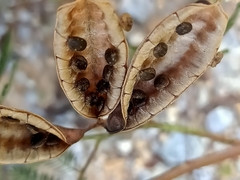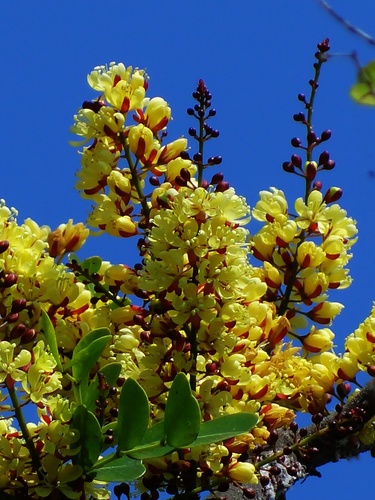
Bloodwood Tree
Haematoxylum campechianum L.
Names
| English | Bloodwood Tree |
|---|---|
| Dutch | — |
| Spanish | Palo de Campeche |
| Chinese | 墨水树 |
| Scientific name | Haematoxylum campechianum L. |
About this species
Haematoxylum campechianum (blackwood, bloodwood tree, bluewood, campeachy tree, campeachy wood, campeche logwood, campeche wood, Jamaica wood, logwood or logwood tree) is a species of flowering tree in the legume family, Fabaceae, that is native to southern Mexico, and introduced to the Caribbean, northern Central America, and other localities around the world.
The tree was of great economic importance from the 17th century to the 19th century, when it was commonly logged and exported to Europe for use in dyeing fabrics. The modern nation of Belize developed from 17th- and 18th-century logging camps established by the English. The tree's scientific name means "bloodwood" (haima being Greek for blood and xylon for wood).
Read more on Wikipedia · Text: Wikipedia, CC BY-SA 4.0
El palo de Campeche (Haematoxylum campechianum), o palo de tinte, es un árbol de la familia de las leguminosas. Es nativo de Mesoamérica, particularmente de la península de Yucatán y en especial del estado de Campeche. De él se obtiene el colorante hematoxilina. El nombre proviene del griego (haima, sangre y xylon, madera), que podría leerse como "madera que sangra". Aparte de para extraer el colorante, su madera se usa para leña y para postes. Las hojas y ramas sirven como forraje. Las flores producen miel. Debido a sus flores atractivas se le utiliza como ornato alrededor de las casas.
Seguir leyendo en Wikipedia · Texto: Wikipedia, CC BY-SA 4.0
墨水树(学名:Haematoxylum campechianum,又称logwood,bloodwood,blackwood,campeachy wood)是豆科采木属的植物,也是开花植物,原产于中南美洲,分布于台湾、中美以及中国大陆的广东、云南等地,目前已由人工引种栽培。
在维基百科上阅读更多 · 文字:维基百科,CC BY-SA 4.0
Classification
| Kingdom | Plantae |
|---|---|
| Phylum | Tracheophyta |
| Class | Magnoliopsida |
| Order | Fabales |
| Family | Fabaceae |
| Genus | Haematoxylum |