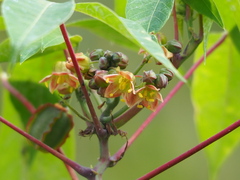
Spurge family: cassava & rubber
Cassava
Manihot esculenta Crantz
Names
| English | Cassava |
|---|---|
| Dutch | Cassave |
| Spanish | Guacamote |
| Chinese | 木薯 |
| Sranan Tongo | kasaba |
| Surinamese Dutch | cassave |
| Scientific name | Manihot esculenta Crantz |
About this species
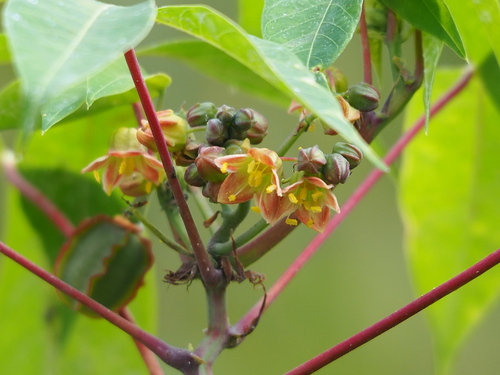
Manihot esculenta, commonly called cassava, manioc, or yuca (among numerous regional names), is a woody shrub of the spurge family, Euphorbiaceae, native to South America, from Brazil, Paraguay and parts of the Andes. Although a perennial plant, cassava is extensively cultivated in tropical and subtropical regions as an annual crop for its edible starchy tuberous root. Cassava is predominantly consumed in boiled form, but substantial quantities are processed to extract cassava starch, called tapioca, which is used for food, animal feed, and industrial purposes. The Brazilian farofa, and the related garri of West Africa, is an edible coarse flour obtained by grating cassava roots, pressing moisture off the obtained grated pulp, and finally drying and roasting it.
Cassava is the third-largest source of carbohydrates in food in the tropics, after rice and maize, making it an important staple; more than 500 million people depend on it. It offers the advantage of being exceptionally drought-tolerant, and able to grow productively on poor soil.
Read more on Wikipedia · Text: Wikipedia, CC BY-SA 4.0
Manihot esculenta, llamada comúnmente yuca, aipim, rumo, casabe, casava, guacamota, lumu, mandioca o mandi'o (en guaraní), es un arbusto perenne de la familia de las euforbiáceas extensamente cultivado en América, África y Oceanía por sus raíces con almidones de alto valor alimentario.
Es originaria del centro de América del Sur y se ha cultivado en la mayor parte de las zonas tropicales y subtropicales del continente americano. También se introdujo con gran éxito en zonas africanas de similares condiciones climáticas, aunque se estima que la gran mayoría de las variedades actualmente cultivadas y conocidas que no son venenosas son efecto de la selección artificial; hay igualmente variedades naturales venenosas generadas por el aislamiento geográfico de la selva (casabe, que es altamente venenosa) o la de los altiplanos (mandioca, mínimamente venenosa).
Seguir leyendo en Wikipedia · Texto: Wikipedia, CC BY-SA 4.0
木薯(学名:Manihot esculenta),又称树薯,是一种大戟科木薯属植物,原产于南美洲。广泛种植于尼日利亚、泰国、巴西、印度尼西亚等100多个国家或地区, 是全球第六大粮食作物, 也是第三大能量来源。
在维基百科上阅读更多 · 文字:维基百科,CC BY-SA 4.0
Classification
| Kingdom | Plantae |
|---|---|
| Phylum | Tracheophyta |
| Class | Magnoliopsida |
| Order | Malpighiales |
| Family | Euphorbiaceae |
| Genus | Manihot |
In Suriname
Where it has been recorded
- Sipaliwini7
- Para3
- Paramaribo3
- Marowijne1
- Saramacca1
Districts with at least one record that has coordinates. Shaded districts have records.
Records by month
All years combined.