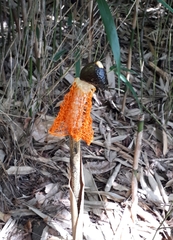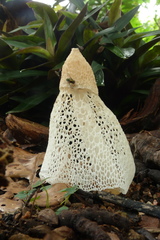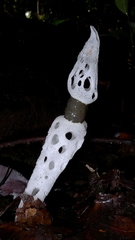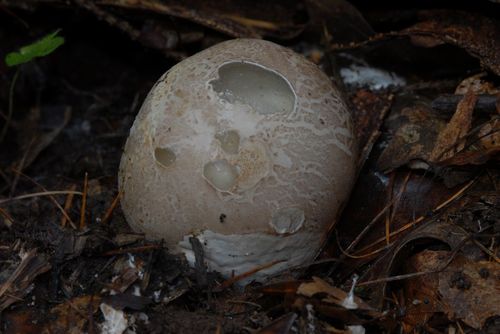
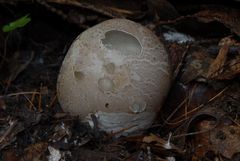
Common stinkhorn
Phallus impudicus L.
Names
| English | Common stinkhorn |
|---|---|
| Dutch | Grote stinkzwam |
| Spanish | Falo hediondo |
| Chinese | 白鬼笔 |
| Sranan Tongo | popolipo (general name for the group) |
| Scientific name | Phallus impudicus L. |
About this species
Phallus impudicus, known colloquially as the common stinkhorn, is a widespread species of fungus in the Phallaceae (stinkhorn) family. It is recognizable for its foul odor and its phallic shape when mature, the latter feature giving rise to several names in 17th-century England.
It is a common mushroom in Europe and North America, where it occurs in habitats rich in wood debris, such as forests and mulched gardens. It appears from summer to late autumn. The fruiting structure is tall and white with a slimy, dark olive colored conical head. Known as the gleba, this material contains the spores, and is transported by insects which are attracted by the odor—described as resembling carrion.
Despite its foul smell, it is not usually poisonous and immature mushrooms are consumed cooked on their own or feature as an ingredient in cuisines of parts of the Czech Republic, France and Germany.
Read more on Wikipedia · Text: Wikipedia, CC BY-SA 4.0
El falo hediondo (Phallus impudicus) es un hongo común en Europa, Norteamérica, y algunas regiones de Sudamérica, fácilmente reconocible cuando está maduro por su mal olor y su forma fálica. Crece sobre suelos húmedos y ricos en restos vegetales, como bosques y jardines con abundante vegetación. Los cuerpos fructíferos aparecen desde el verano hasta el final del otoño, generalmente agrupados.
El estípite es largo y blanco, con retículos, coronado por un sombrerete cónico, recubierto por la gleba, de color verde oscuro, fétida y viscosa. En su base hay una volva rosada, resto del velo que lo recubre en las primeras fases de su desarrollo. A pesar de su mal olor cuando está desarrollado, este hongo no es venenoso, y en su etapa juvenil, cuando el velo aún no se ha abierto, es consumido en algunos lugares de Francia y Alemania.
Su olor penetrante, a carne en putrefacción, atrae a las moscas, que son las que diseminan sus esporas. En años de gran fructificación, el olor es perceptible a distancia.
Sus esporas miden de 3-4.5 x 1-2µm, son elípticas, lisas e incoloras.
Seguir leyendo en Wikipedia · Texto: Wikipedia, CC BY-SA 4.0
白鬼笔(学名:Phallus impudicus),又名竹下菌、无裙竹荪,是一种广泛分布于北美洲、欧洲和中国的真菌,从夏季到深秋在富有粗木质残体的林地和园中群生或单生,是一种食用蕈类。白鬼笔会散发恶臭的气味,白色蕈柄较高,顶部是覆有暗绿色黏液的圆锥形蕈伞,而这些产孢组织中的孢子是靠被腐肉气味吸引来的昆虫传播的。其恶臭的气味和成熟时典型的短粗毛笔外形,使人们很容易辨识出白鬼笔。虽然白鬼笔的气味很难闻且鬼笔属的其它生物多数为剧毒,但其并不是毒蕈。白鬼笔的菌柄、菌托可入药,同时在在法国和德国的部分地区也是一种常见的食用菌,不过食用时需去除菌盖和菌托,留下菌柄食用。包括命名人林奈在内的很多人认为其外形像阴茎,因此在17世纪的英国,白鬼笔有很多诨号。
在维基百科上阅读更多 · 文字:维基百科,CC BY-SA 4.0
Classification
| Kingdom | Fungi |
|---|---|
| Phylum | Basidiomycota |
| Class | Agaricomycetes |
| Order | Phallales |
| Family | Phallaceae |
| Genus | Phallus |