About this species
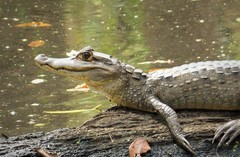
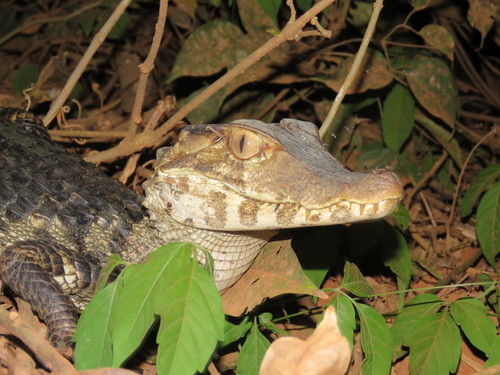
Cuvier's dwarf caiman (Paleosuchus palpebrosus) is a small crocodilian in the alligator family from northern and central South America. It is found in Bolivia, Brazil, Colombia, Ecuador, French Guiana, Guyana, Paraguay, Peru, Suriname, Trinidad and Venezuela. It lives in riverine forests, flooded forests near lakes, and near fast-flowing rivers and streams. It can traverse dry land to reach temporary pools and tolerates colder water than other species of caimans. Other common names for this species include the musky caiman, the dwarf caiman, Cuvier's caiman, and the smooth-fronted caiman (the latter name is also used for P. trigonatus). It is sometimes kept in captivity as a pet and may be referred to as the wedge-head caiman by the pet trade community.
Cuvier's dwarf caiman was first described by the French zoologist Georges Cuvier in 1807 and is one of only two species in the genus Paleosuchus, the other species being P. trigonatus. Their closest relatives are the other caimans in the subfamily Caimaninae.
Read more on Wikipedia · Text: Wikipedia, CC BY-SA 4.0
El caimán de Cuvier (Paleosuchus palpebrosus), también llamado yacaré itá, yacaré enano, caimán enano o babo morichalero, es una especie de pequeño caimán sudamericano presente en varios países: Argentina, Bolivia, Brasil, Colombia, Ecuador, Guyana, Paraguay, Perú, Surinam y Venezuela.
Los machos alcanzan 1,6 metros de longitud en su edad adulta y las hembras 1,2 metros
Son la especie de cocodrilo más pequeña del mundo. Es una de las especies del orden crocodilia menos amenazada cuyas poblaciones se mantienen estables.
Por lo general este tipo de caimán muestra preferencia por cursos de agua con corriente y más aún por aquellos donde la vegetación provea de sombra. En estos lugares las hembras colocan sus nidos, fabricados por ellas son hechos de hojas secas. La puesta usual consta de 5 a 9 huevos.
Seguir leyendo en Wikipedia · Texto: Wikipedia, CC BY-SA 4.0
钝吻古鳄(学名Paleosuchus palpebrosus),又称矮鳄鱼、盾吻古鳄、钝吻侏儒凯门鳄,是一种生活在南美洲北部和中部的小型鳄鱼,是世界上体型最小的鳄鱼品种之一,成年后体型最小可到1.2米,身体上的皮有骨板加以强化,体色为啡色,加以深啡色或黑色的横向带状斑纹,口鼻部平滑,双眼之间无骨脊。
钝吻古鳄主要分布于南美洲北部,栖息在洪泛森林里。这种鳄鱼会用腐烂的植物于泥巴筑巢,雌鳄每次生12只蛋。
分布在玻利维亚、巴西、哥伦比亚、厄瓜多尔、圭亚那、巴拉圭、秘鲁、苏里南和委内瑞拉。它们主要栖息在河滨森林和湖、河畔的洪溢林。它们可以忍受其他短吻鳄无法承受的低温,在干旱时节能穿越干地寻找水源。
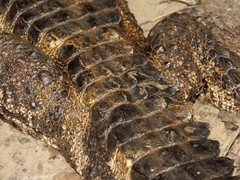
钝吻古鳄是新大陆鳄鱼中体型最小的。雄性体长1.6米,雌性不超过1.2米。有记录的最大的钝吻古鳄长1.72米。成体重6-7千克。钝吻古鳄无论背侧还是腹侧都有厚实的鳞甲,如此一来即使它们体型较小,也不怕掠食者的威胁。
钝吻古鳄通常是夜行性的。成年鳄鱼以鱼类、两栖类、小型哺乳类、鸟类、螃蟹、虾、软体动物和其他无脊椎动物为食。亚成体则主要捕食鱼类、甲壳类、蝌蚪、蛙类和蜗牛和其他陆生无脊椎动物,如甲虫。
在维基百科上阅读更多 · 文字:维基百科,CC BY-SA 4.0
Classification
| Kingdom | Animalia |
|---|---|
| Phylum | Chordata |
| Class | Crocodylia |
| Family | Alligatoridae |
| Genus | Paleosuchus |
In Suriname
Where it has been recorded
- Commewijne2
- Nickerie1
- Para1
- Sipaliwini1
Districts with at least one record that has coordinates. Shaded districts have records.
Records by month
All years combined.