Domestic Water Buffalo
Bubalus bubalis (Linnaeus, 1758)
Names
| English | Domestic Water Buffalo |
|---|---|
| Dutch | Gedomesticeerde Waterbuffel |
| Spanish | Búfalo de agua |
| Chinese | 家水牛 |
| Scientific name | Bubalus bubalis (Linnaeus, 1758) |
About this species
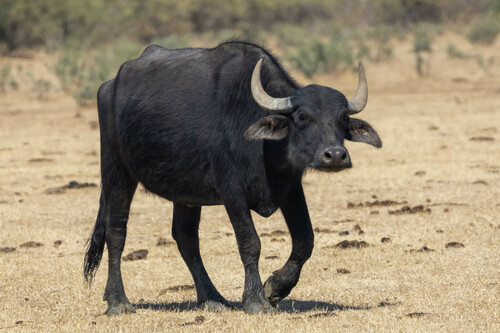
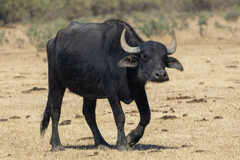
The water buffalo (Bubalus bubalis), also called domestic water buffalo, Asian water buffalo, and Asiatic water buffalo, is a large domesticated bovine originating in South and Southeast Asia descended from the wild water buffalo. Today, it is also kept in regions including Italy, the Balkans, Australia, the Americas, and parts of Africa. Two extant types of water buffalo are recognized, based on morphological and behavioural criteria: the river buffalo of the Indian subcontinent and further west to the Balkans, Egypt, and Italy; and the swamp buffalo from Assam in the west through Southeast Asia to the Yangtze Valley of China in the east.
The wild water buffalo (Bubalus arnee) is most probably the ancestor of the domestic water buffalo. Phylogenetic analysis indicates that the river-type water buffalo probably originated in western India and was domesticated about 6,300 years ago, whereas the swamp-type originated independently from Mainland Southeast Asia and was domesticated about 3,000 to 7,000 years ago.
Read more on Wikipedia · Text: Wikipedia, CC BY-SA 4.0
El búfalo de agua, búfalo común, búfalo indio o búfalo asiático (Bubalus bubalis) es un mamífero herbívoro que pertenece a la familia de los bóvidos. Tiene su origen en el sudeste de Asia y al subcontinente indio, donde se han encontrado fósiles de sus antepasados.
Existen dos variedades principales: el búfalo doméstico y el búfalo salvaje. El búfalo doméstico se ha adaptado a diferentes climas y regiones, y se utiliza para la producción de carne, leche, cuero y como animal de tiro. El búfalo salvaje, en cambio, está en peligro de extinción y solo se conserva en algunas áreas protegidas de Asia.
Seguir leyendo en Wikipedia · Texto: Wikipedia, CC BY-SA 4.0
水牛(学名:Bubalus bubalis),也称亚洲水牛,古名牨(gāng),是一种大的偶蹄动物,因早期农业所需,驯养的水牛在亚洲非常普遍。
水牛体格粗壮,被毛稀疏,多为灰黑色;角粗大而扁,并向后方弯曲;皮厚、汗腺极不发达,热时需要浸水散热,所以得名水牛;腿短蹄大,适合耕作;役力、泌乳量和耐粗性都比黄牛高;乳脂率8%左右,乳脂白;肉质较粗。
在亚洲,水牛主要用来作为劳动力;在欧洲的意大利、罗马尼亚和保加利亚它被用做奶牛或食用牛。今天在印度、尼泊尔、不丹和泰国还有野生水牛,澳大利亚北部也有野生的水牛。在东南亚的野生水牛的来历不是很清楚,它们可能是由变野的驯养的水牛的后代,也可能是本地原来就有的野生水牛的后代,或是两者的交配产物。今天野生的水牛已经相当少了。另外,美洲野牛在部份中文翻译为水牛,但并非水牛。
水牛的分类还有争议,Mac Greger于1941年认为水牛只有一种,下分两个亚种:河水牛(B. bubalus arnee)和沼泽水牛(B. bubalus carabanesis)。其他专家将两者分为相互的独立的种类。
水牛奶较牛奶的含脂量高,因此较容易保存。意大利著名的马苏里拉奶酪及流行于珠江三角洲的特产双皮奶就是用水牛奶制成的。
不像黄牛,水牛在印度教文化代表邪恶,是阎王和恶魔的坐骑,是祭女神的供品;依据美国农业部的统计,次于巴西、澳洲、美国,目前印度是全球第四大牛肉出口国,而出口的就是水牛肉,但印度教徒本身多不食用。
台湾牛较可靠的纪录是在荷兰时期由荷兰人输入,在那之前台湾可能无牛。
在维基百科上阅读更多 · 文字:维基百科,CC BY-SA 4.0
Classification
| Kingdom | Animalia |
|---|---|
| Phylum | Chordata |
| Class | Mammalia |
| Order | Artiodactyla |
| Family | Bovidae |
| Genus | Bubalus |