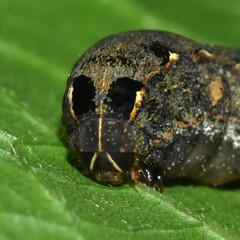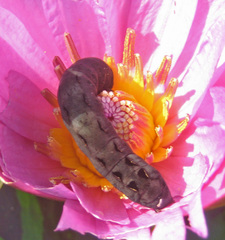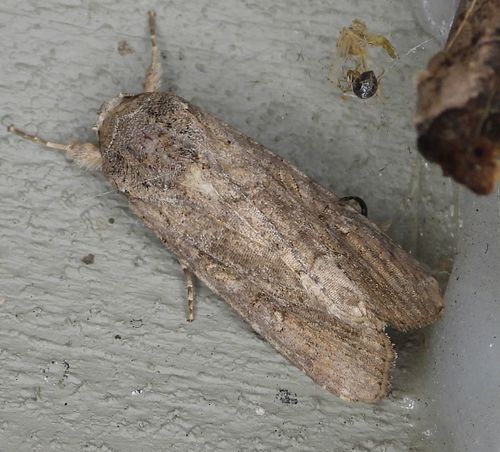
Fall Armyworm Moth
Spodoptera frugiperda J.E.Smith, 1797
Names
| English | Fall Armyworm Moth |
|---|---|
| Dutch | — |
| Spanish | Cogollero del maíz |
| Chinese | 草地贪夜蛾 |
| Sranan Tongo | kapelka (general name for the group) |
| Scientific name | Spodoptera frugiperda J.E.Smith, 1797 |
About this species
The fall armyworm (Spodoptera frugiperda) is a species in the order Lepidoptera and one of the species of the fall armyworm moths distinguished by their larval life stage. The term "armyworm" can refer to several species, often describing the large-scale invasive behavior of the species' larval stage. It is regarded as a pest and can damage and destroy a wide variety of crops, which causes large economic damage. Its scientific name derives from frugiperda, which is Latin for lost fruit, named because of the species' ability to destroy crops. Because of its propensity for destruction, the fall armyworm's habits and possibilities for crop protection have been studied in depth. It is also a notable case for studying sympatric speciation, as it appears to be diverging into two species currently. Another remarkable trait of the larva is that they consistently practice cannibalism, despite its fitness costs.
The fall armyworm is active at a different time of year from the true armyworm, another species in the order Lepidoptera and family Noctuidae, but of the genus Mythimna.
Read more on Wikipedia · Text: Wikipedia, CC BY-SA 4.0
Spodoptera frugiperda, ook wel legerrups of legerworm, is een vlinder uit de familie van de uilen (Noctuidae). De wetenschappelijke naam van de soort is voor het eerst geldig gepubliceerd in 1797 door Smith & Abbot.
De vlinders worden gezien als een plaag. Ze verplaatsen zich in zwermen, waarbij de rupsen al het graan in een gebied kunnen opeten. Een dergelijk geval deed zich in 1998 voor in de staat Illinois in de Verenigde Staten. Als bestrijdingswijze was de hoop gevestigd op genetisch gemodificeerde planten die dodelijk zouden zijn voor de rupsen, maar sommige rupsen bleken hiertegen resistent. Biologische bestrijding van de vlinders is mogelijk met de schildwesp Chelonus insularis, die haar eitjes legt in Spodoptera frugiperda en waarin de larven zich ontwikkelen.
Lees verder op Wikipedia · Tekst: Wikipedia, CC BY-SA 4.0
El cogollero del maíz (Spodoptera frugiperda) es una especie de lepidóptero ditrisio de la familia Noctuidae, muy conocida en el ámbito agrícola por ser una plaga bastante importante que ataca a diversos cultivos de importancia económica, tales como maíz (Zea mays) y algodón (Gossypium spp.)
De su tejido ovárico derivan dos líneas celulares (Sf9 y Sf21) que son muy usadas actualmente para la investigación biomédica, como por ejemplo, para la infección con baculovirus o la expresión de proteínas recombinantes.
Seguir leyendo en Wikipedia · Texto: Wikipedia, CC BY-SA 4.0
草地贪夜蛾(学名:Spodoptera frugiperda),又称秋行军虫、秋粘虫、草地夜蛾,是夜蛾科夜盗蛾属的一种蛾。本种可能正发生同域种化,渐分化为分布地区与外形没有明显差异的两个亚型,其幼虫分别以玉米和水稻为主要食草。生物研究中常用于表达真核蛋白质的细胞株Sf9细胞与Sf21细胞即是来自草地贪夜蛾。另外本种的幼虫除了食用植物外,另一个显著特征是它们还有同类相食的行为,惟其演化意义仍不清楚。
草地贪夜蛾在农业上属于害虫,其幼虫可大量啃食禾本科如水稻、甘蔗和玉米之类细粒禾榖及菊科、十字花科等多种农作物,造成严重的经济损失,其发育的速度会随著气温的提升而变快,一年可繁衍数代,一只雌蛾即可产下超过1000颗卵。本种原产于美洲热带地区,具有很强的迁徙能力,虽不能在零度以下的环境越冬,但仍可于每年气温转暖时迁徙至美国东部与加拿大南部各地,美国历史上即发生过数次草地贪夜蛾的虫灾。2016年起,草地贪夜蛾散播至非洲、亚洲各国,并于2018年12月开始经缅甸传入中国大陆,并散播至台湾、韩国与日本等国家或地区,对多国或地区造成巨大的农业损失。
在维基百科上阅读更多 · 文字:维基百科,CC BY-SA 4.0
Classification
| Kingdom | Animalia |
|---|---|
| Phylum | Arthropoda |
| Class | Insecta |
| Order | Lepidoptera |
| Family | Noctuidae |
| Genus | Spodoptera |
In Suriname
Where it has been recorded
- Paramaribo9
Districts with at least one record that has coordinates. Shaded districts have records.
Records by month
All years combined.