Mallow family: kapok, cacao & okra
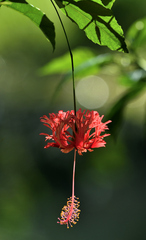
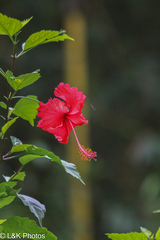
Fork-bracted rosemallow
Hibiscus bifurcatus Cav.
Names
| English | Fork-bracted rosemallow |
|---|---|
| Dutch | — |
| Spanish | Mala mujer |
| Chinese | — |
| Scientific name | Hibiscus bifurcatus Cav. |
About this species
Hibiscus bifurcatus, also known as the fork-bracted rose-mallow, is a species of tropical hibiscus native to parts of Central and South America, including Mexico, Peru, and Brazil. The species is typically found in open woodlands, forest margins, and coastal regions, where it benefits from the warm, humid conditions characteristic of these environments. These natural habitats provide the plant with an adequate supply of sunlight, moderate moisture, and well-draining soil, conditions that are crucial for its survival. The plant grows primarily at altitudes ranging from sea level to approximately 1,500 m (4,900 ft). In these Regions, the temperature is relatively stable, with daily high temperatures between 24 and 30 °C (75 and 86 °F) and low temperatures rarely dipping below 18 °C (64 °F). The species is adapted to environments that experience distinct wet and dry seasons, though it prefers conditions with consistent moisture availability throughout the year.
Read more on Wikipedia · Text: Wikipedia, CC BY-SA 4.0
Hibiscus bifurcatus es una especie de hibisco perteneciente a la familia de las malváceas. Es originaria de América. En Cuba recibe el nombre de majagüilla del pinar.
Seguir leyendo en Wikipedia · Texto: Wikipedia, CC BY-SA 4.0
Classification
| Kingdom | Plantae |
|---|---|
| Phylum | Tracheophyta |
| Class | Magnoliopsida |
| Order | Malvales |
| Family | Malvaceae |
| Genus | Hibiscus |
In Suriname
Where it has been recorded
- Sipaliwini8
- Brokopondo6
- Nickerie2
- Marowijne1
- Para1
Districts with at least one record that has coordinates. Shaded districts have records.
Records by month
All years combined.