Fulvous Whistling-Duck
Dendrocygna bicolor (Vieillot, 1816)
Names
| English | Fulvous Whistling-Duck |
|---|---|
| Dutch | Rosse Fluiteend |
| Spanish | Pijije canelo |
| Chinese | 茶色树鸭 |
| Sranan Tongo | doksi (general name for the group) |
| Scientific name | Dendrocygna bicolor (Vieillot, 1816) |
About this species
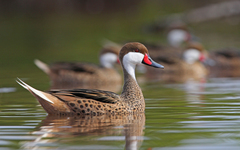
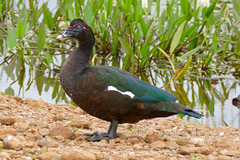
The fulvous whistling duck or fulvous tree duck (Dendrocygna bicolor) is a species of whistling duck that breeds across the world's tropical regions in much of Mexico and South America, the West Indies, the southern United States, sub-Saharan Africa and the Indian subcontinent. It has plumage that is mainly reddish brown, long legs and a long grey bill, and shows a distinctive white band across its black tail in flight. Like other members of its ancient lineage, it has a whistling call which is given in flight or on the ground. Its preferred habitat consists of wetlands with plentiful vegetation, including shallow lakes and paddy fields.
The nest, built from plant material and unlined, is placed among dense vegetation or in a tree hole. The typical clutch is around ten whitish eggs. The breeding adults, which pair for life, take turns to incubate, and the eggs hatch in 24–29 days. The downy grey ducklings leave the nest within a day or so of hatching, but the parents continue to protect them until they fledge around nine weeks later.
Read more on Wikipedia · Text: Wikipedia, CC BY-SA 4.0
El sirirí colorado (Dendrocygna bicolor), también conocido como pato silbón colorado o suirirí bicolor, es una especie de ave anseriforme de la familia Anatidae y la subfamilia Anatinae.
Habita en todas las regiones tropicales del mundo: en gran parte de Centro y Sudamérica, las Indias Occidentales, el sur de los Estados Unidos, África subsahariana y el subcontinente indio. Tiene un plumaje principalmente pardo rojizo, piernas largas y un pico largo y gris, y una franja blanca distintiva en toda la cola negra durante el vuelo. Al igual que otros miembros de su antiguo linaje, tiene una llamada ruidosa que en vuelo o en el suelo. El hábitat preferido son los lagos poco profundos, arrozales y otros humedales con vegetación abundante.
El nido, construido con material vegetal y sin forrar, es construido entre la vegetación densa o en el hueco de un árbol. La puesta típica tiene alrededor de diez huevos blanquecinos. La pareja reproductora, cuyos miembros permanecen juntos toda la vida, se turna para incubar los huevos; estos eclosionan en 24-29 días.
Seguir leyendo en Wikipedia · Texto: Wikipedia, CC BY-SA 4.0
草黄树鸭(学名:Dendrocygna bicolor)是分布在热带地区的树鸭属,包括中美洲、南美洲、撒哈拉以南非洲、印度次大陆及美国墨西哥湾沿岸地区。
种名 bicolor 意为“二色的”。
在维基百科上阅读更多 · 文字:维基百科,CC BY-SA 4.0
Classification
| Kingdom | Animalia |
|---|---|
| Phylum | Chordata |
| Class | Aves |
| Order | Anseriformes |
| Family | Anatidae |
| Genus | Dendrocygna |
In Suriname
Where it has been recorded
- Commewijne1
- Nickerie1
Districts with at least one record that has coordinates. Shaded districts have records.
Records by month
All years combined.