Sloths, anteaters & armadillos
Giant Anteater
Myrmecophaga tridactyla Linnaeus, 1758
Names
| English | Giant Anteater |
|---|---|
| Dutch | Reuzenmiereneter |
| Spanish | Oso hormiguero gigante |
| Chinese | 大食蚁兽 |
| Sranan Tongo | tamanuwa |
| Sranan Tongo | tamanwa |
| Scientific name | Myrmecophaga tridactyla Linnaeus, 1758 |
About this species
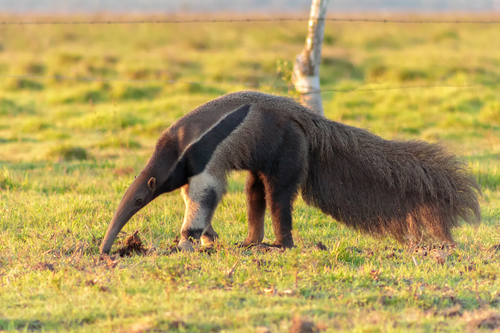
The giant anteater (Myrmecophaga tridactyla) is an insectivorous mammal native to Central and South America. It is the largest of the four living species of anteaters, which are classified with sloths in the order Pilosa. The only extant member of the genus Myrmecophaga, the giant anteater is mostly terrestrial, in contrast to other living anteaters and sloths, which are arboreal or semiarboreal. It is recognizable by its elongated snout, bushy tail, long foreclaws, and distinctively colored fur.
The giant anteater is found in multiple habitats, including grassland and rainforest. It forages in open areas and rests in more forested habitats. It feeds primarily on ants and termites, using its foreclaws to dig them up and its long, sticky tongue to collect them. Though giant anteaters live in overlapping home ranges, they are mostly solitary except during mother-offspring relationships, aggressive interactions between males, and when mating. Mother anteaters carry their offspring on their backs until weaning them.
Read more on Wikipedia · Text: Wikipedia, CC BY-SA 4.0
El oso hormiguero gigante, también llamado oso palmero, oso bandera, tamandúa bandera, yurumí o ñurumí, es una especie de mamífero piloso de la familia de los mirmecofágidos que se encuentra en América Central y América del Sur. Es la única especie viviente del género Myrmecophaga y la más grande de oso hormiguero.
Seguir leyendo en Wikipedia · Texto: Wikipedia, CC BY-SA 4.0
大食蚁兽(学名:Myrmecophaga tridactyla)是异关节总目披毛目食蚁兽的一种,为一种大型的食虫动物,和树懒为近亲。分布在中美洲与南美洲部分地区,生活在草地、落叶林和雨林地区。主要以蚂蚁和白蚁为食,一天最多可食30,000只昆虫。
大食蚁兽在现存四种食蚁兽中体型最大的成员,体长可达 182—217 cm(5.97—7.12英尺)。雄性体重通常为 33—41千克(73—90磅),雌性则为 27—39千克(60—86磅)。体毛长而坚硬,可长40厘米,尾部密生长毛,头细长,眼耳极小并吻成管状,无齿,舌细长并能伸缩,借以舐食蚁类、白蚁及其他昆虫。前肢除第五指外,均具钩爪,后肢短,五爪大小相仿。体灰白色,背面两侧有宽阔的黑色纵纹,纹的边缘白色。大食蚁兽为独居动物,个体之间少有互动,少数例外为:雄性之间的示威、交配、以及养育后代。雌性大食蚁兽会将幼仔背在背上活动。
大食蚁兽被国际自然保护联盟列为易危物种,在许多地区面临局部地区灭绝。大食蚁兽所面临的威胁包括栖息地丧失以及盗猎取得其毛皮与肉。
包括两个亚种:
Myrmecophaga tridactyla artata Osgood, 1912
Myrmecophaga tridactyla centralis Lyon, 1906
在维基百科上阅读更多 · 文字:维基百科,CC BY-SA 4.0
Classification
| Kingdom | Animalia |
|---|---|
| Phylum | Chordata |
| Class | Mammalia |
| Order | Pilosa |
| Family | Myrmecophagidae |
| Genus | Myrmecophaga |
In Suriname
Where it has been recorded
- Brokopondo7
- Sipaliwini4
- Commewijne1
Districts with at least one record that has coordinates. Shaded districts have records.
Records by month
All years combined.
