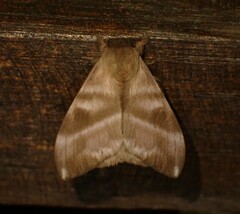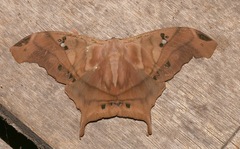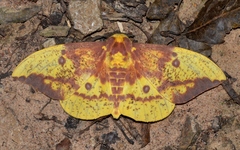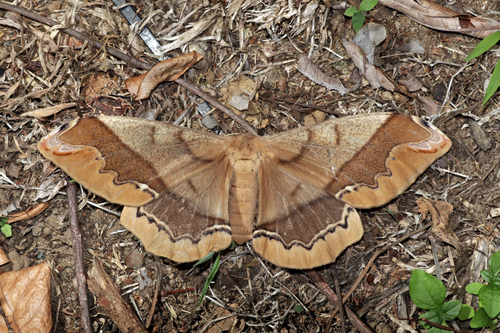
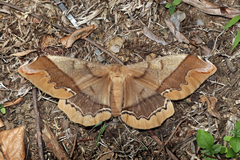
Giant silk moth
Arsenura armida Cramer, 1780
Names
| English | Giant silk moth |
|---|---|
| Dutch | — |
| Spanish | Cuetla |
| Chinese | — |
| Sranan Tongo | kapelka (general name for the group) |
| Scientific name | Arsenura armida Cramer, 1780 |
About this species
Arsenura armida, the giant silk moth, is a moth of the family Saturniidae. It is found mainly in South and Central America, from Mexico to Bolivia, and Ecuador to south-eastern Brazil. It was first described by Pieter Cramer in 1779.
It is the only known Neotropical arsenurinae to exhibit a combination of strong aposematism, gregariousness, and trail-following behavior in its larval stage. The larvae are brightly colored, with bright black and yellow bands, which signal their unpleasant taste to birds. The larvae are also fatally poisonous to some species of birds. During the day, the larvae rest in large conspicuous masses on the trunks of trees, and descend at night to feed. When returning at dawn, they follow a silk-less pheromone trail to their original central place location. This social behavior is remarkable for the larvae; other members of the genus live more solitary lives.
The larvae feed on Guazuma ulmifolia, Rollinia membranacea and Bombacopsis quinatum.
Read more on Wikipedia · Text: Wikipedia, CC BY-SA 4.0
Arsenura armida is een vlinder uit de onderfamilie Arsenurinae van de familie nachtpauwogen (Saturniidae).
De wetenschappelijke naam van de soort is voor het eerst geldig gepubliceerd door Pieter Cramer in 1779.
Lees verder op Wikipedia · Tekst: Wikipedia, CC BY-SA 4.0
Classification
| Kingdom | Animalia |
|---|---|
| Phylum | Arthropoda |
| Class | Insecta |
| Order | Lepidoptera |
| Family | Saturniidae |
| Genus | Arsenura |
In Suriname
Where it has been recorded
- Sipaliwini4
- Commewijne2
Districts with at least one record that has coordinates. Shaded districts have records.