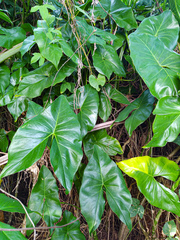
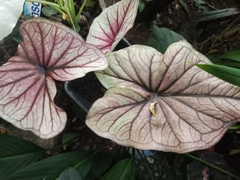
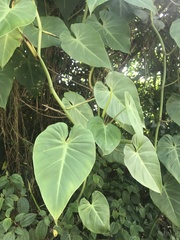
Giant taro
Alocasia macrorrhizos (L.) G.Don
Names
| English | Giant taro |
|---|---|
| Dutch | Alocasie |
| Spanish | Hoja pintada |
| Chinese | 热亚海芋 |
| Scientific name | Alocasia macrorrhizos (L.) G.Don |
About this species
Alocasia macrorrhizos is a species of flowering plant in the arum family (Araceae) that is native to rainforests of Maritime Southeast Asia, New Guinea, and the Murray Islands group in the Torres Strait of Australia. It has long been cultivated in South Asia, the Philippines, many Pacific islands, and elsewhere in the tropics, in the order of tens of thousands of years. Common names include giant taro, giant alocasia, ʻape, biga, and pia. In Australia it is known as the cunjevoi (a term which also refers to a marine animal).
Read more on Wikipedia · Text: Wikipedia, CC BY-SA 4.0
海芋,港澳称为海芋,台湾称为兰屿姑婆芋(学名:Alocasia macrorrhizos),为天南星科海芋属植物,是常见观赏植物,原出东南亚及澳洲原始森林,亦见诸华南及兰屿等地,俗称痕芋头、狼毒(广东)、野芋头、山芋头、大根芋、大虫芋、天芋、天蒙,作为观赏植物时则称其为「滴水观音」,这是因为如果环境湿度过大,会从它阔大的叶片上往下滴水,其花是肉穗花序,外有一大型绿色佛焰苞,开展成舟型,如同观音座像。
海芋是多年生草本,叶阔大,在中国大陆北方需在室内越冬,在南方可以露地生长,球茎和叶可以作为药用,但有剧毒,须长时间烹煮;其叶汁含有草酸钙,可引起皮肤过敏。
在维基百科上阅读更多 · 文字:维基百科,CC BY-SA 4.0
Classification
| Kingdom | Plantae |
|---|---|
| Phylum | Tracheophyta |
| Class | Liliopsida |
| Order | Alismatales |
| Family | Araceae |
| Genus | Alocasia |
In Suriname
Where it has been recorded
- Paramaribo2
Districts with at least one record that has coordinates. Shaded districts have records.