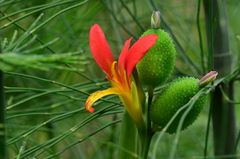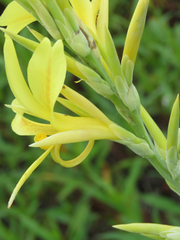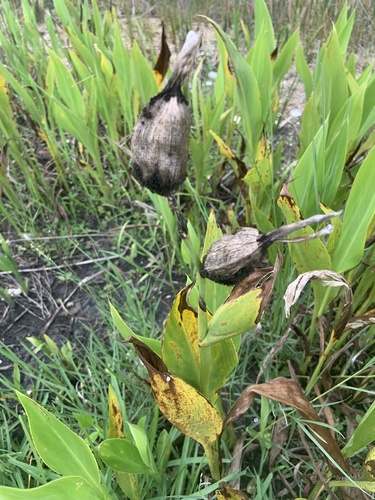
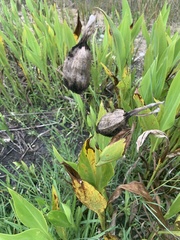
Golden Canna
Canna flaccida Salisb.
Names
| English | Golden Canna |
|---|---|
| Dutch | — |
| Spanish | — |
| Chinese | 柔瓣美人蕉 |
| Scientific name | Canna flaccida Salisb. |
About this species
Canna flaccida, sometimes referred to as the bandanna of the Everglades, is a species of the Canna genus, a member of the family Cannaceae. The species is indigenous to the wetlands of the south-central and south-eastern United States from Texas to South Carolina. It is also reportedly naturalized in India, the Philippines, Mexico, Panama, Cuba, the Dominican Republic, Peru and southern Brazil.
Canna flaccida was a parent to many of the early-hybridised cannas originally known as orchid flowered cannas, but now correctly named as Italian Group cannas. It grows well as a water canna. Originally described by the early American explorer, William Bartram, when he found these plants blooming near the rivers of coastal Georgia. The seed floats down the rivers and becomes easily established on shorelines. Introduced to England in 1788.
Canna flaccida is a perennial growing to 1.5 m (4 ft 11 in). It is hardy to zone 10 and is frost tender. In the north latitudes it is in flower from August to October, and the seeds ripen in October. The flowers are hermaphrodite.
Read more on Wikipedia · Text: Wikipedia, CC BY-SA 4.0
柔瓣美人蕉(学名:Canna flaccida)为美人蕉科美人蕉属的植物。分布于南美洲以及中国大陆的南北各省等地,目前已由人工引种栽培。
在维基百科上阅读更多 · 文字:维基百科,CC BY-SA 4.0
Classification
| Kingdom | Plantae |
|---|---|
| Phylum | Tracheophyta |
| Class | Liliopsida |
| Order | Zingiberales |
| Family | Cannaceae |
| Genus | Canna |
In Suriname
Where it has been recorded
- Paramaribo1
Districts with at least one record that has coordinates. Shaded districts have records.