Songbirds & other perching birds
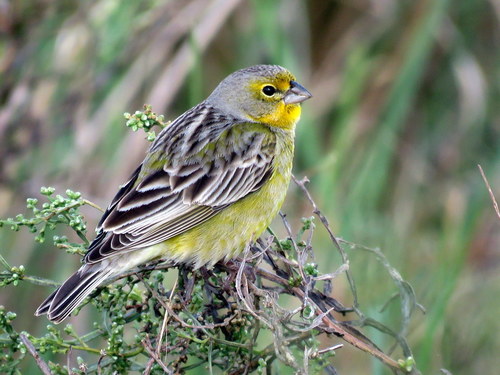
Grassland Yellow-Finch
Sicalis luteola (Sparrman, 1789)
Names
| English | Grassland Yellow-Finch |
|---|---|
| Dutch | Graslandsaffraangors |
| Spanish | Gorrión Canario Sabanero |
| Chinese | 草原黄雀鹀 |
| Scientific name | Sicalis luteola (Sparrman, 1789) |
About this species
The grassland yellow finch (Sicalis luteola) is a small passerine bird. Despite its name, it is not a finch, but is a seedeater. These were formerly united with the buntings and American sparrows in the Emberizidae, but are now known to be tanagers.
It is a resident in tropical South America, from Colombia south and east to the Guianas and central Ecuador, Peru and Brazil. Birds which breed further south in Argentina and Uruguay migrate to Bolivia and southern Brazil, (the cerrado etc.), in the austral winter. There are also isolated populations in Central America and Mexico. It was discovered on Trinidad in 2004, presumably having colonised from nearby Venezuela. Also known from Barbados, certainly since 1960 if not earlier.
The grassland yellow finch, as its name implies, is found in fields and other open grassland. The female lays 3 brown-speckled pale blue-green eggs in a grassy cup nest in tall grass, and several pairs may breed close to each other in suitable areas.
The grassland yellow finch is about 12 cm long and weighs 13 g.
Read more on Wikipedia · Text: Wikipedia, CC BY-SA 4.0
El chirigüe sabanero (Sicalis luteola) es una especie de ave paseriforme de la familia Thraupidae perteneciente al género Sicalis. Tiene una amplia distribución que incluye México y América Central –donde es el único Sicalis presente–, las Antillas menores –donde fue introducido– y Sudamérica.
Seguir leyendo en Wikipedia · Texto: Wikipedia, CC BY-SA 4.0
Classification
| Kingdom | Animalia |
|---|---|
| Phylum | Chordata |
| Class | Aves |
| Order | Passeriformes |
| Family | Thraupidae |
| Genus | Sicalis |
In Suriname
Where it has been recorded
- Paramaribo6
- Sipaliwini2
Districts with at least one record that has coordinates. Shaded districts have records.