Greater Yellow-headed Vulture
Cathartes melambrotus Wetmore, 1964
Names
| English | Greater Yellow-headed Vulture |
|---|---|
| Dutch | Grote Geelkopgier |
| Spanish | Aura selvática |
| Chinese | 大黄头美洲鹫 |
| Sranan Tongo | opete (general name for the group) |
| Sranan Tongo | dyankro (general name for the group) |
| Scientific name | Cathartes melambrotus Wetmore, 1964 |
About this species
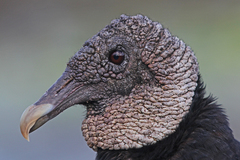
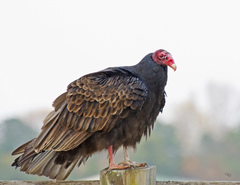
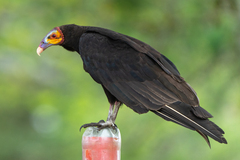
The greater yellow-headed vulture (Cathartes melambrotus), also known as the forest vulture, is a species of bird in the New World vulture family Cathartidae. It was considered to be the same species as the lesser yellow-headed vulture until they were split in 1964. It is found in South America in tropical moist lowland forests. It is a fairly large bird, with a wingspan of 166–178 cm (65–70 in), a weight of 1.65 kilograms (3.6 lb) and a body length of 64–75 cm (25–30 in). The body plumage is black, and the head and neck, which are featherless, range in color from deep yellow to pale orange. It lacks a syrinx, and its vocalizations are therefore limited to grunts or low hisses.
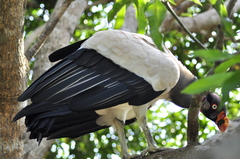
The greater yellow-headed vulture feeds on carrion and locates carcasses by sight and by smell, an ability which is rare in birds. It is dependent on larger vultures, such as the king vulture, to open the hides of larger animal carcasses, as its bill is not strong enough to do this. Like other New World vultures, the greater yellow-headed vulture utilizes thermals to stay aloft with minimal effort.
Read more on Wikipedia · Text: Wikipedia, CC BY-SA 4.0
El aura selvática (Cathartes melambrotus) es una especie de ave Cathartiformes de la familia Cathartidae. Es también conocido como zamuro grande de cabeza amarilla, guala amazónica, urubú de la selva, urubú grande de cabeza amarilla y oripopo cabeza amarilla mayor.
Era considerada la misma especie que el aura sabanera (Cathartes burrovianus) hasta que ambas especies fueron separadas taxonómicamente en 1964.
No se conocen subespecies.
Habita los bosques tropicales húmedos de tierras bajas en Sudamérica y el sur de América Central.
Es un ave bastante grande, con una envergadura de 165 a 210 cm, un peso de 1,2 a 3,2 kg y un tamaño de 70-84 cm de largo.
El plumaje del cuerpo es negro y la cabeza y el cuello, que no tienen plumas, varían en color de amarillo profundo a naranjo pálido. Carece de una siringe y sus vocalizaciones se limitan a gruñidos y siseos bajos.
Se alimenta de carroña y localiza los cadáveres a la vista y el olfato, una capacidad poco común en las aves.
Seguir leyendo en Wikipedia · Texto: Wikipedia, CC BY-SA 4.0
Classification
| Kingdom | Animalia |
|---|---|
| Phylum | Chordata |
| Class | Aves |
| Order | Accipitriformes |
| Family | Cathartidae |
| Genus | Cathartes |
In Suriname
Where it has been recorded
- Sipaliwini799
- Brokopondo463
- Para323
- Commewijne120
- Paramaribo44
- Nickerie19
- Saramacca16
- Marowijne7
- Wanica4
- Coronie1
Districts with at least one record that has coordinates. Shaded districts have records.
Records by month
All years combined.