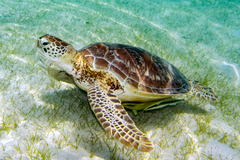
Green Sea Turtle
Chelonia mydas (Linnaeus, 1758)
Names
| English | Green Sea Turtle |
|---|---|
| Dutch | Soepschildpad |
| Spanish | Tortuga verde |
| Chinese | 绿海龟 |
| Sranan Tongo | sekrepatu (general name for the group) |
| Scientific name | Chelonia mydas (Linnaeus, 1758) |
About this species
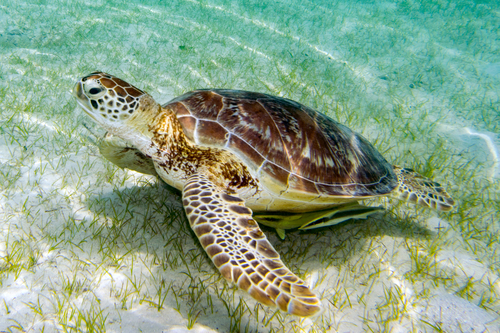
The green sea turtle (Chelonia mydas), also known as the green turtle, black sea turtle, and Pacific green turtle, is a species of large sea turtle of the family Cheloniidae. It is the only species in the genus Chelonia. Its range extends throughout tropical and subtropical seas around the world, with two distinct populations in the Atlantic and Pacific Oceans, but it is also found in the Indian Ocean. The common name refers to the usually green fat found beneath its carapace, due to its diet strictly being seagrass, not to the color of its carapace, which is olive to black.
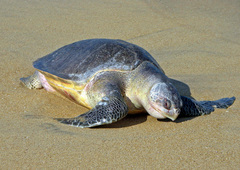
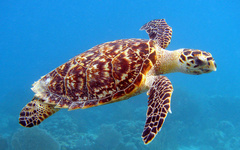
The dorsoventrally flattened body of C. mydas is covered by a large, teardrop-shaped carapace; it has a pair of large, paddle-like flippers. It is usually lightly colored, although in the eastern Pacific populations, parts of the carapace can be almost black. Unlike other members of its family, such as the hawksbill sea turtle, C. mydas is mostly herbivorous. The adults usually inhabit shallow lagoons, feeding mostly on various species of seagrasses.
Read more on Wikipedia · Text: Wikipedia, CC BY-SA 4.0
La tortuga verde (Chelonia mydas) es una especie de tortuga marina de la familia Cheloniidae. Esta tortuga de gran tamaño se distribuye por los mares tropicales y subtropicales alrededor del mundo, con dos poblaciones distintas en los océanos Atlántico y Pacífico. El nombre común de la especie deriva del color verde de su grasa, y no del color de su caparazón. Como especie reconocida en peligro de extinción por la UICN y la CITES, su explotación está prohibida en casi todos los países del mundo. Es ilegal capturar, dañar o matar tortugas de este tipo. Adicionalmente, algunos países han implementado varias leyes para proteger a las tortugas y sus sitios de anidación dentro de su jurisdicción. Sin embargo, la población de tortugas aún está en peligro de extinción debido a algunas prácticas humanas. En algunos países, las tortugas son aún cazadas por su carne y sus huevos son recolectados de los nidos para ser comidos. La contaminación daña también indirectamente a las poblaciones de tortugas. Muchas tortugas quedan atrapadas en las redes de pesca y mueren ahogadas.
Seguir leyendo en Wikipedia · Texto: Wikipedia, CC BY-SA 4.0
绿蠵(xī)龟(学名:Chelonia mydas、英语:green sea turtle),又称绿海龟、青海龟、石龟(台罗:tsio̍h-ku)、龟鼊(台罗:ku-piah)、龟蟞(台罗:ku-phi̍ah),是海洋中的爬行类动物,是海龟属下的唯一一种。一生中大多的时间都在海中生活,但演化过程中仍然保留了部分祖先的生活方式,所以必须回到出生地上产卵,繁育后代,形成了一种较独特的生活习性。
绿蠵龟广泛分布在热带及亚热带海域中,即约南北纬度60等温线之间的海域,并在水温逾摄氏25度的沙滩上产卵。由于牠用肺呼吸,于海中的潜水深度极限约一、两百公尺。绿蠵龟的主食为海中的海草与大型海藻,因此体内脂肪累积了许多绿色色素,呈现淡绿色,也因而得名。
绿蠵龟已濒临绝种,全世界仅剩下约20万头产卵母龟,在世界自然保护联盟濒危物种红色名录中列为濒危物种。为避免因人类的捕杀及栖地之破坏,所有海龟被均列为濒危野生动植物种国际贸易公约(或简称华盛顿公约)附录中的物种,也被选为世界自然基金会的海洋十宝之一。
在维基百科上阅读更多 · 文字:维基百科,CC BY-SA 4.0
Classification
| Kingdom | Animalia |
|---|---|
| Phylum | Chordata |
| Class | Testudines |
| Family | Cheloniidae |
| Genus | Chelonia |
In Suriname
Where it has been recorded
- Commewijne16
- Marowijne8
- Sipaliwini1
Districts with at least one record that has coordinates. Shaded districts have records.
Records by month
All years combined.
Sources & credits
- Records: GBIF.org occurrence data for Suriname
- Observations and names: iNaturalist
- Names in other languages: Wikidata
- Sranan names: Explore Suriname Sranan Tongo dictionary
- Suriname status: National Zoological Collection of Suriname (NZCS) checklists
- Photo: Paul Asman and Jill Lenoble, CC BY 4.0, via iNaturalist