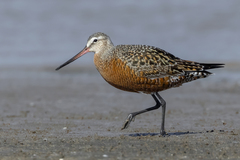
Hudsonian Godwit
Limosa haemastica (Linnaeus, 1758)
Names
| English | Hudsonian Godwit |
|---|---|
| Dutch | Rode Grutto |
| Spanish | Picopando del Este |
| Chinese | 棕塍鹬 |
| Scientific name | Limosa haemastica (Linnaeus, 1758) |
About this species
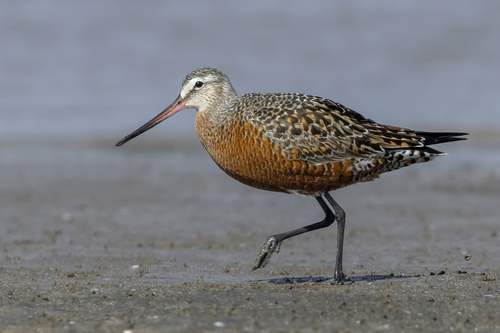
The Hudsonian godwit (Limosa haemastica) is a large shorebird in the sandpiper family, Scolopacidae. It is an extreme long-distance migrant, breeding at remote sites in Subarctic North America and flying nonstop in the fall to wintering sites in southern South America. Due to its remote breeding and wintering grounds and rapid, direct migration, it was a poorly-known species and was considered very rare until the mid-20th century, when major staging sites were discovered around James Bay and breeding sites were found around Churchill, Manitoba. Since then, the Hudsonian godwit has become the target of conservation attention due to its fragmented and localized distribution and small population, as well as an important scientific system for migration biology research.
Read more on Wikipedia · Text: Wikipedia, CC BY-SA 4.0
El aguja café (Limosa haemastica), también denominada zarapito pico recto, aguja parda, becasa de mar, picopando canelo, barga aliblanca, aguja lomiblanca y aguja de Hudson, es una especie de ave Charadriiforme de la familia Scolopacidae propia de América, y divagante en Europa y Australia.
Seguir leyendo en Wikipedia · Texto: Wikipedia, CC BY-SA 4.0
Classification
| Kingdom | Animalia |
|---|---|
| Phylum | Chordata |
| Class | Aves |
| Order | Charadriiformes |
| Family | Scolopacidae |
| Genus | Limosa |
In Suriname
Where it has been recorded
- Saramacca4
- Coronie3
- Paramaribo3
- Nickerie2
- Commewijne1
Districts with at least one record that has coordinates. Shaded districts have records.
Records by month
All years combined.