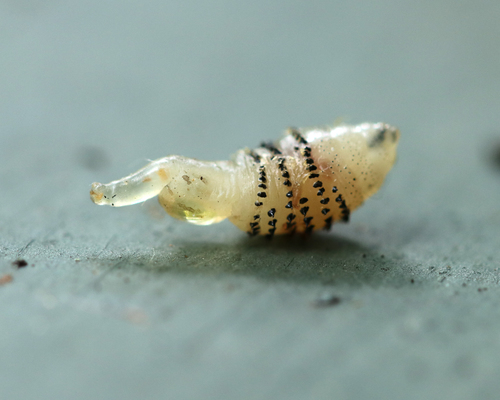
Human Botfly
Dermatobia hominis (Linnaeus, 1781)
Names
| English | Human Botfly |
|---|---|
| Dutch | — |
| Spanish | Rezno |
| Chinese | 人皮肤蝇 |
| Scientific name | Dermatobia hominis (Linnaeus, 1781) |
About this species
The human botfly, Dermatobia hominis (Greek δέρμα, skin + βίος, life, and Latin hominis, of a human), is a species of botfly whose larvae parasitise humans (in addition to a wide range of other animals, including other primates). It is also known as the torsalo or American warble fly, though the warble fly is in the genus Hypoderma and not Dermatobia, and is a parasite on cattle and deer instead of humans.
Dermatobia fly eggs have been shown to be vectored by over 40 species of mosquitoes and muscoid flies, as well as one species of tick (however, the source for this is somewhat old — 2007 — and slightly more recent literature seems to indicate they don't need a particular species of tick, or at least makes no mention of them only being able to use one as a vector). The female captures the mosquito and attaches its eggs to its body, then releases it. Either the eggs hatch while the mosquito is feeding and the larvae use the mosquito bite area as the entry point, or the eggs simply drop off the muscoid fly when it lands on the skin.
Read more on Wikipedia · Text: Wikipedia, CC BY-SA 4.0
Dermatobia hominis (Grieks δέρμα, huid + βίος, leven, en Latijn hominis, van een mens), is een soort horzel waarvan de larven ook op mensen parasiteren.
Er is aangetoond dat eitjes van Dermatobia hominis worden overgebracht door meer dan 40 soorten muggen en muskusvliegen, evenals door sommige teken. Het horzelvrouwtje vangt de mug en hecht haar eieren aan de mug, waarna ze deze loslaat. Ofwel de eieren komen uit terwijl de mug zich voedt en gebruiken de larven de plek van de muggenbeet als ingang, ofwel de eieren vallen gewoon van de vlieg af wanneer deze op de huid landt. De larven ontwikkelen zich in de onderhuidse lagen en na ongeveer acht weken vallen ze eruit om zich minstens een week te verpoppen, meestal in de grond. De volwassen vliegen zijn grote vliegen zonder monddelen (zoals ook geldt voor andere horzels).
De soort is inheems in Noord- en Zuid-Amerika, van zuidoost Mexico (beginnend in centraal Veracruz) tot noordelijk Argentinië en Uruguay, maar is niet talrijk/schadelijk genoeg is om ooit een echte plaagstatus te bereiken.
Lees verder op Wikipedia · Tekst: Wikipedia, CC BY-SA 4.0
El rezno, ura o tórsalo (Dermatobia hominis) (del griego δέρμα, "piel" y βίος, "vida", y del latín hominis, "de los humanos", o sea, que vive en la piel de los humanos) es una especie de díptero braquícero. Es la única mosca de la muerte o éstrido que parasita al ser humano, también parasita a muchos otros mamíferos. Es la única especie del género Dermatobia
Esta especie es nativa de gran parte del continente americano, desde México hasta el norte de Argentina, Chile y Uruguay, aunque no es lo suficientemente abundante ni perjudicial como para ser considerada una auténtica plaga. Las erupciones que producen en la piel muestran poca tendencia a infectarse, probablemente porque la larva segrega antibióticos como estrategia adaptativa para que la propia larva disponga de alimento en buen estado. La infección es mucho más probable si la larva es sólo parcialmente extraída al intentar eliminarla, dejando restos bajo la piel.
Seguir leyendo en Wikipedia · Texto: Wikipedia, CC BY-SA 4.0
人皮蝇(学名:Dermatobia hominis),是狂蝇科皮肤蝇属的唯一种。其幼虫寄生于人类(以及广泛的其他动物,包括其他灵长类动物)。
已证明人皮蝇的卵可被40多种蚊子和粘蝇以及一种蜱虫传播;雌人皮蝇捕获蚊子并将卵附着在其身上,然后将其释放。附着在蚊子身上的人皮蝇卵在蚊子进食时孵化,幼虫通过蚊子的叮咬区域作为入口点;或是当粘蝇落在皮肤上时,人皮蝇卵从粘蝇身上掉下来。幼虫在宿主的皮下层发育,大约8周后,它们离开宿主并用至少一周时间化蛹,通常在土壤中。人皮蝇成虫是类似大黄蜂的大型苍蝇,很容易被识别,因为它们没有口器(其他肤蝇也是如此)。
人皮蝇原产于美洲,从墨西哥东南部(从韦拉克鲁斯中部开始)到阿根廷北部、智利和乌拉圭,尽管它的数量不够丰富(也不够有害),无法达到真正的害虫状态。通常,它们对人类构成的最大风险是增加感染的机会,因为它们会为它们的呼吸孔造成开放性伤口。欧洲也报告了一些病例。因为人皮蝇幼虫只有在宿主伤口不愈合的情况下才能在整个8周的发育过程中存活下来,患者很少会发生感染,除非他们在没有完全清除幼虫的情况下杀死幼虫。
在维基百科上阅读更多 · 文字:维基百科,CC BY-SA 4.0
Classification
| Kingdom | Animalia |
|---|---|
| Phylum | Arthropoda |
| Class | Insecta |
| Order | Diptera |
| Family | Oestridae |
| Genus | Dermatobia |