Hymenocallis tubiflora
Names
| English | — |
|---|---|
| Dutch | — |
| Spanish | — |
| Chinese | — |
| Scientific name | Hymenocallis tubiflora Salisb. |
About this species
Hymenocallis tubiflora is a plant species from Trinidad and northern South America. It is reported from Trinidad, Venezuela, Guyana, Suriname, French Guiana, and northern Brazil. The name was originally coined in 1812, the description based on a specimen grown at Kew Botanical Garden in London, the bulb having been seized by British sailors from a French ship captured by the Royal Navy in 1803.
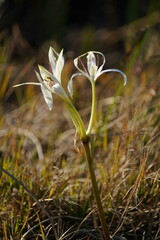
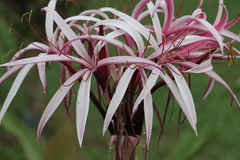
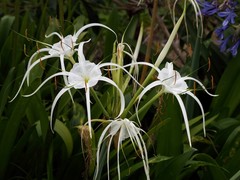
Hymenocallis tubiflora is a bulb-forming perennial. It has broadly lanceolate leaves up to 60 cm long, tapering at the tip and narrowing below to a long petiole. Flowers are white, borne in an umbel; tepals long and narrow, frequently drooping at flowering time; staminal cup short. Anthers yellow, borne on long filaments.
Read more on Wikipedia · Text: Wikipedia, CC BY-SA 4.0
El lirio hermoso de Venezuela (Hymenocallis tubiflora) es una especie de planta bulbosa geófita perteneciente a la familia de las amarilidáceas. Se distribuye desde Trinidad y Tobago hasta el norte de Brasil.
Seguir leyendo en Wikipedia · Texto: Wikipedia, CC BY-SA 4.0
Classification
| Kingdom | Plantae |
|---|---|
| Phylum | Tracheophyta |
| Class | Liliopsida |
| Order | Asparagales |
| Family | Amaryllidaceae |
| Genus | Hymenocallis |
In Suriname
Where it has been recorded
- Sipaliwini14
- Brokopondo1
- Marowijne1
- Para1
Districts with at least one record that has coordinates. Shaded districts have records.
Records by month
All years combined.