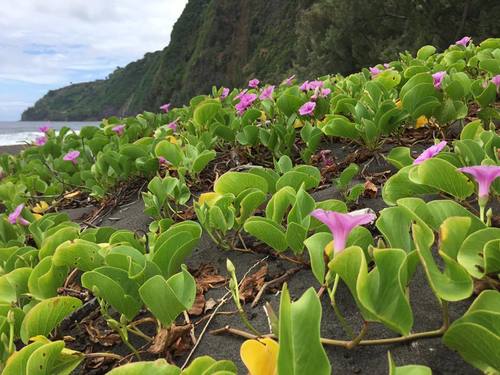

Morning glories & sweet potato
Beach Morning Glory
Ipomoea pes-caprae (L.) R.Br.
Names
| English | Beach Morning Glory |
|---|---|
| Dutch | Geitenhoefwinde |
| Spanish | Bejuco de mar |
| Chinese | 厚藤 |
| Scientific name | Ipomoea pes-caprae (L.) R.Br. |
About this species
Ipomoea pes-caprae, also known as bayhops, bay-hops, beach morning glory, railroad vine, or goat's foot, is a common pantropical creeping vine belonging to the family Convolvulaceae. It grows on the upper parts of beaches and endures salted air. It is one of the most common and most widely distributed salt tolerant plants and provides one of the best known examples of oceanic dispersal. Its seeds float and are unaffected by salt water.
Originally described by Linnaeus, it was placed in its current genus by Robert Brown in 1818.
Read more on Wikipedia · Text: Wikipedia, CC BY-SA 4.0
Ipomoea pes-caprae (batatilla, bejuco rastrero, churristate de playa o bejuco de playa) es una especie botánica de enredadera común tropical de la familia de las Convolvulaceae. En Cuba se llama boniato de playa.
Seguir leyendo en Wikipedia · Texto: Wikipedia, CC BY-SA 4.0
厚藤(学名:Ipomoea pes-caprae),又名马鞍藤(福建、广东、广西)、沙灯心(广东)、马蹄草、鲎藤(福建)、海薯、走马风、马六藤、白花藤(浙江)、海茹藤、二裂牵牛、二叶红薯、红花马鞍藤、马蹄金、狮藤、海薯藤、沙藤,是一种常见于热带地区的旋花科牵牛花属多年生匍匐蔓生草本植物。厚藤的叶先端明显凹陷或是接近两裂。厚藤生长在海滩较高的地区并且能在含盐的环境生长。
在维基百科上阅读更多 · 文字:维基百科,CC BY-SA 4.0
Classification
| Kingdom | Plantae |
|---|---|
| Phylum | Tracheophyta |
| Class | Magnoliopsida |
| Order | Solanales |
| Family | Convolvulaceae |
| Genus | Ipomoea |
In Suriname
Where it has been recorded
- Nickerie3
- Commewijne2
Districts with at least one record that has coordinates. Shaded districts have records.
Records by month
All years combined.


