Cup fungi, moulds & other fungi
Neurospora crassa
Names
| English | — |
|---|---|
| Dutch | — |
| Spanish | — |
| Chinese | 粗糙脉孢菌 |
| Scientific name | Neurospora crassa Shear & B.O.Dodge |
About this species
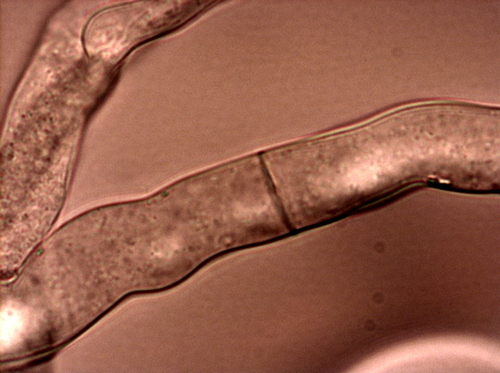
Neurospora crassa is a type of red bread mold of the phylum Ascomycota. The genus name, meaning 'nerve spore' in Greek, refers to the characteristic striations on the spores. The first published account of this fungus was from an infestation of French bakeries in 1843.
Neurospora crassa is used as a model organism because it is easy to grow and has a haploid life cycle that makes genetic analysis simple since recessive traits will show up in the offspring. Analysis of genetic recombination is facilitated by the ordered arrangement of the products of meiosis in Neurospora ascospores. Its entire genome of seven chromosomes has been sequenced.
Neurospora was used by Edward Tatum and George Wells Beadle in their experiments for which they won the Nobel Prize in Physiology or Medicine in 1958. Beadle and Tatum exposed N. crassa to X-rays, causing mutations. They then observed failures in metabolic pathways caused by errors in specific enzymes. This led them to propose the "one gene, one enzyme" hypothesis that specific genes code for specific proteins.
Read more on Wikipedia · Text: Wikipedia, CC BY-SA 4.0
Neurospora crassa is een rode broodschimmel, die behoort tot de ascomyceten. De eerste gepubliceerde vermelding betrof aantastingen in Franse bakkerijen in 1843.
Het is in de biologie een bekend modelorganisme, die gemakkelijk op een kunstmatig groeimedium te kweken is. Door de haploïde levenscyclus is een genetische analyse eenvoudig uit te voeren, omdat de expressie van recessieve genen direct zichtbaar is bij de nakomelingen. De analyse van de recombinatie is gemakkelijker door de volgorde van de meiose producten in de ascospore. De ascosporen liggen namelijk op één rij.
Neurospora crassa werd door Edward Tatum en George Wells Beadle als onderzoeksmodel gekozen. Voor hun werk verkregen ze in 1958 de Nobelprijs voor de Fysiologie of Geneeskunde. Voor het opwekken van mutaties werd de schimmel bestraald met ioniserende stralen. Aansluitend werd de stofwisseling onderzocht op defecte enzymatische activiteit. Uit de onderzoeksresultaten werd door hen de één gen op één enzym hypothese opgesteld, één gen codeert voor één enzym.
Lees verder op Wikipedia · Tekst: Wikipedia, CC BY-SA 4.0
Neurospora crassa es una especie de hongo moho de la división Ascomycota que suele estar presente en panes. El nombre de su género, significa "espora nerviosa" en griego, ya que se refiere a las estrías características de sus esporas. La primera vez que se detectó a este hongo fue en 1843 cuando infectó a panes de una panadería francesa.
En investigación científica, Neurospora crassa se usa como organismo modelo porque es fácil de cultivar y tiene un ciclo de vida haploide que simplifica el análisis genético ya que sus genes recesivos aparecen en la descendencia. El análisis de la recombinación genética se ve facilitado por la disposición ordenada de los productos de meiosis en las ascosporas de Neurospora crassa. Se ha secuenciado todo su genoma en siete cromosomas.
Neurospora crassa fue utilizado por Edward Tatum y George Wells Beadle en sus experimentos por los que ganaron el Premio Nobel de Medicina y Fisiología de 1958. Beadle y Tatum expuesieron a Neurospora crassa a rayos X, causando mutaciones.
Seguir leyendo en Wikipedia · Texto: Wikipedia, CC BY-SA 4.0
粗糙脉孢菌(学名:Neurospora crassa),又称粗糙脉孢霉、粉色面包霉菌、红面包霉菌等,是一种属于子囊菌门的一种霉菌。由于生长容易,且拥有单倍体世代,使隐性遗传可直接展现,进而使遗传学分析较为简易,因此是一种生物学上的模式生物。本属名字意为“神经孢子”,指的是孢子 中的特征条纹。这种真菌的第一次发布是于1843年从法国面包店的侵染。
N. crassa的早期研究者乔治·比德尔(George Wells Beadle)与爱德华·塔特姆(Edward Tatum),在实验中利用X射线照射使N. crassa发生突变,进而观察到因酵素失效而遭破坏的生化代谢途径,并由此确立了基因编码与蛋白质的关系。两人因此获得1958年诺贝尔生理学或医学奖。
N. crassa拥有的全部7条染色体,完整的基因组已经大致定序完成。并于2003年4月24日发表于《自然》期刊。其基因组大小约43Mb,含有约1万个基因。目前正在进行每一个N. crassa基因的基因敲除(knockout)测试。
在自然环境中,N. crassa主要生活在热带和亚热带地区。它被发现可以在火灾后死去的植物物质里生长。
N. crassa被积极应用于世界各地的研究。它是在参与昼夜节律,表观遗传学和基因静默,细胞极性,细胞融合,发育,以及细胞生物学和生物化学的许多方面阐明重要的分子事件。
菌株和N. crassa工作的其他材料都可以从真菌遗传学现货中心(Fungal Genetics Stock Center) (页面存档备份,存于互联网档案馆)获得。
在维基百科上阅读更多 · 文字:维基百科,CC BY-SA 4.0
Classification
| Kingdom | Fungi |
|---|---|
| Phylum | Ascomycota |
| Class | Sordariomycetes |
| Order | Sordariales |
| Family | Sordariaceae |
| Genus | Neurospora |
In Suriname
Where it has been recorded
- Brokopondo1
Districts with at least one record that has coordinates. Shaded districts have records.