Cats, otters & other carnivores
Ocelot
Leopardus pardalis (Linnaeus, 1758)
Names
| English | Ocelot |
|---|---|
| Dutch | Ocelot |
| Spanish | Ocelote |
| Chinese | 虎猫 |
| Sranan Tongo | tigrikati |
| Sranan Tongo | tigri (general name for the group) |
| Scientific name | Leopardus pardalis (Linnaeus, 1758) |
About this species
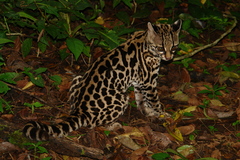
The ocelot (Leopardus pardalis) is a medium-sized spotted wild cat that reaches 40–50 cm (16–20 in) at the shoulders and weighs between 7 and 15.5 kg (15 and 34 lb) on average. It is native to the southwestern United States, Mexico, Central and South America, and the Caribbean islands of Trinidad and Margarita. Carl Linnaeus scientifically described it in 1758. Two subspecies are recognized.
The ocelot is efficient at climbing, leaping and swimming. It prefers areas close to water sources with dense vegetation cover and high prey availability. It preys on small terrestrial mammals, such as armadilloes, opossums, and lagomorphs. It is typically active during twilight and at night and tends to be solitary and territorial. Both sexes become sexually mature at around two years of age and can breed throughout the year; peak mating season varies geographically. After a gestation period of two to three months, the female gives birth to a litter of one to three kittens. They stay with their mother for up to two years, after which they leave to establish their own home ranges.
Read more on Wikipedia · Text: Wikipedia, CC BY-SA 4.0
El ocelote (del náhuatl océlotl; Leopardus pardalis) es una especie de mamífero carnívoro de la familia Felidae. Se encuentra ampliamente distribuido en América, principalmente en ambientes tropicales, donde se diferencia en numerosas subespecies. Puede confundirse con el margay o tigrillo (Leopardus wiedii).
Seguir leyendo en Wikipedia · Texto: Wikipedia, CC BY-SA 4.0
虎猫(学名:Leopardus pardalis,英语:ocelot)又名美洲豹猫,是产于南美、中美和墨西哥以及美国最南端、加勒比地区的野生猫科动物。体长可达100厘米,尾长45厘米,体重10-15千克,是虎猫属中体型最大的一种。同属的小斑虎猫和长尾虎猫与其外表相近,分布于同一地区。虎猫在圈养条件下可以与小斑虎猫、长尾虎猫、乔氏猫或南美林猫杂交,但是它们在野外并不杂交。
虎猫的皮毛接近美洲豹,因此被遭到大量的捕杀,面临生存的威胁。
种加词 pardalis 意为“豹纹的”、“长满斑点的”。
在维基百科上阅读更多 · 文字:维基百科,CC BY-SA 4.0
Classification
| Kingdom | Animalia |
|---|---|
| Phylum | Chordata |
| Class | Mammalia |
| Order | Carnivora |
| Family | Felidae |
| Genus | Leopardus |
In Suriname
Where it has been recorded
- Brokopondo677
- Sipaliwini23
- Paramaribo2
Districts with at least one record that has coordinates. Shaded districts have records.
Records by month
All years combined.