Pomegranate
Punica granatum L.
Names
| English | Pomegranate |
|---|---|
| Dutch | Granaatappel |
| Spanish | Granada cordelina |
| Chinese | 石榴 |
| Sranan Tongo | granaki |
| Scientific name | Punica granatum L. |
About this species
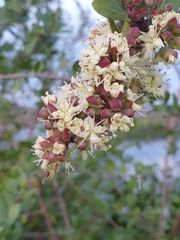
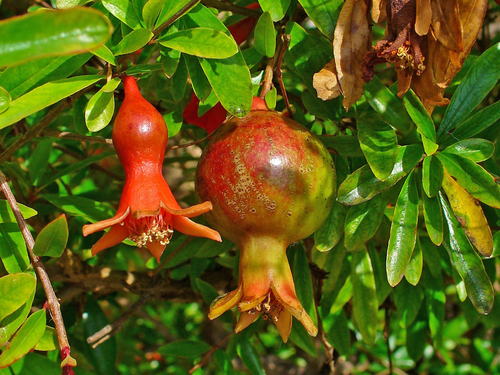
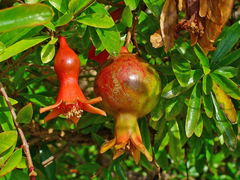
The pomegranate (Punica granatum) is a fruit-bearing, deciduous shrub in the family Lythraceae, subfamily Punicoideae, that grows to between 1.5–5 metres (5–16 ft) tall. Rich in symbolic and mythological associations in many cultures, it originated in the region spanning the Caucasus and the Iranian plateau — including modern-day Iran, Turkmenistan, Afghanistan and Pakistan. Pomegranate was first domesticated by ancient Iranians in the Iranian plateau and nearby regions about 5,000 years ago. It is extensively cultivated for its fruit.
Pomegranate was exported from the Iranian plateau to other parts of Asia including Iraq, Turkey, and India, as well as parts of Africa and Europe. It was also introduced into Spanish America in the late 16th century and into California by Spanish settlers in 1769.
Although the pomegranate is indigenous to Iran and its nearby regions, it is also nowadays cultivated across West Asia, South Asia, Central Asia, north and Sub-Saharan Africa, the drier parts of Southeast Asia, the Mediterranean basin, United States and Chile.
Read more on Wikipedia · Text: Wikipedia, CC BY-SA 4.0
Punica granatum, llamado comúnmente granado, es una especie de planta de la familia Lythraceae, cuyo fruto es la granada. Nativa de la región desde Irán hasta el Himalaya, se ha cultivado desde la antigüedad por toda la cuenca mediterránea.
Seguir leyendo en Wikipedia · Texto: Wikipedia, CC BY-SA 4.0
石榴(学名:Punica granatum),或称安石榴,千屈菜科灌木。
在维基百科上阅读更多 · 文字:维基百科,CC BY-SA 4.0
Classification
| Kingdom | Plantae |
|---|---|
| Phylum | Tracheophyta |
| Class | Magnoliopsida |
| Order | Myrtales |
| Family | Lythraceae |
| Genus | Punica |
In Suriname
Where it has been recorded
- Paramaribo2
Districts with at least one record that has coordinates. Shaded districts have records.