True bugs, cicadas & leafhoppers
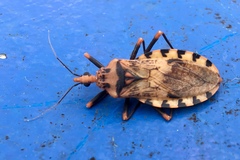
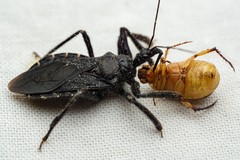
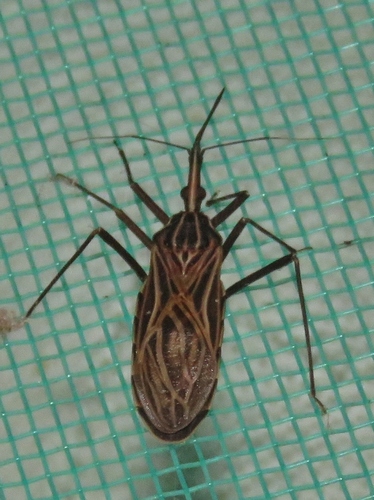
Rhodnius prolixus
Names
| English | — |
|---|---|
| Dutch | — |
| Spanish | Chinche vector de Chagas |
| Chinese | — |
| Scientific name | Rhodnius prolixus Stål, 1859 |
About this species
Rhodnius prolixus is the principal triatomine vector of the Chagas parasite due to both its sylvatic and domestic populations in northern South America as well as to its exclusively domestic populations in Central America. It has a wide range of ecotopes, mainly savanna and foothills with an altitude of between 500 and 1,500 metres (1,640 and 4,921 ft) above sea level and temperatures of 16 to 28 °C (61 to 82 °F). Sylvatic R. prolixus, as virtually all Rhodnius spp., is primarily associated with palm tree habitats and has a wide range of hosts including birds, rodents, marsupials, sloths, and reptiles.
The insect was used by Sir Vincent Wigglesworth for the detection of insect hormones. It has been implicated in the transmission of transposons between it and some of its vertebrate hosts, squirrel monkeys and opossums.
Rhodnius prolixus is also known as the kissing bug (like other triatomine bugs) because it tends to feed on the area around victims' mouths.
Read more on Wikipedia · Text: Wikipedia, CC BY-SA 4.0
Rhodnius prolixus es una especie de insecto hematófago, que pertenece al suborden heteróptera, subfamilia triatominae. Esta especie de interés sanitario, es el segundo vector de mayor importancia de la enfermedad de Chagas (luego de Triatoma infestans) y se le llama vulgarmente chipo o pito, especialmente en Venezuela y Colombia.
Seguir leyendo en Wikipedia · Texto: Wikipedia, CC BY-SA 4.0
Classification
| Kingdom | Animalia |
|---|---|
| Phylum | Arthropoda |
| Class | Insecta |
| Order | Hemiptera |
| Family | Reduviidae |
| Genus | Rhodnius |