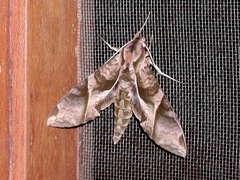
Satellite Sphinx
Eumorpha satellitia Linnaeus, 1771
Names
| English | Satellite Sphinx |
|---|---|
| Dutch | — |
| Spanish | Polilla esfinge satélite |
| Chinese | — |
| Sranan Tongo | kapelka (general name for the group) |
| Scientific name | Eumorpha satellitia Linnaeus, 1771 |
About this species
Eumorpha satellitia, the satellite sphinx, is a moth of the family Sphingidae. The family was first described by Carl Linnaeus in 1771. It lives from Brazil and northern Argentina north through Central America, Mexico, and the West Indies to south Texas and southern Arizona.
The wingspan is 114–134 mm. Adults are on wing from April to August and then again in October. They feed on the nectar of various flowers, including Petunia hybrida, Saponaria officinalis and Lychnis alba.
The larvae feed on Cissus pseudosicyoides and Cissus rhombifolia. Pupation takes place underground.
Read more on Wikipedia · Text: Wikipedia, CC BY-SA 4.0
Eumorpha satellitia is een vlinder uit de familie van de pijlstaarten (Sphingidae). De wetenschappelijke naam werd in 1771 gepubliceerd door Carl Linnaeus.
Lees verder op Wikipedia · Tekst: Wikipedia, CC BY-SA 4.0
Classification
| Kingdom | Animalia |
|---|---|
| Phylum | Arthropoda |
| Class | Insecta |
| Order | Lepidoptera |
| Family | Sphingidae |
| Genus | Eumorpha |
In Suriname
Where it has been recorded
- Sipaliwini1
Districts with at least one record that has coordinates. Shaded districts have records.