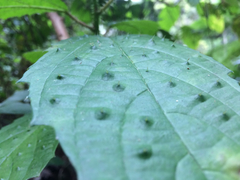
Scratchbush
Urera baccifera (L.) Gaudich.
Names
| English | Scratchbush |
|---|---|
| Dutch | — |
| Spanish | Chichicastle |
| Chinese | 红珠麻 |
| Scientific name | Urera baccifera (L.) Gaudich. |
About this species
Urera baccifera is a species of flowering plant in the nettle family known by many common names, including scratchbush, ortiga brava, pringamoza, mala mujer, chichicaste, nigua, guaritoto, ishanga, manman guêpes, and urtiga bronca. It is native to the Americas from Mexico through Central America into South America, as well as the Caribbean.
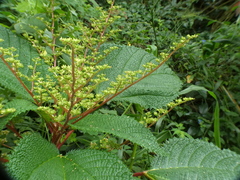
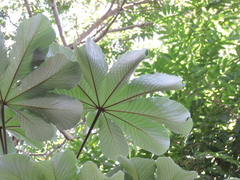
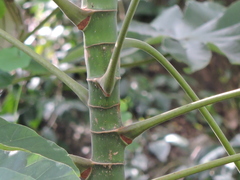
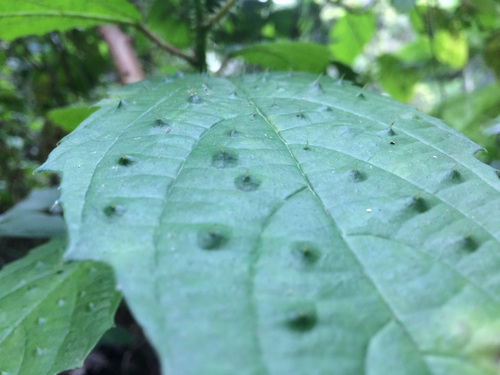
This species is a shrub or a small tree. It can reach five meters in height. The thin, toothed leaves are up to 25 centimeters long by 12.5 wide. The blades are borne on long petioles. The plant is covered in spines and stinging hairs. The inflorescence is a pink or purple cluster of flowers, and the plant is dioecious, with male and female parts on different plants. The spongy, juicy fruit is green or pinkish. The seeds are dispersed by fruit-eating birds and capuchin monkeys.
This plant grows in moist tropical forests. It is not very tolerant of shade, so it dies back when the overstory closes. It can be found in forests recently disturbed by fire.
Read more on Wikipedia · Text: Wikipedia, CC BY-SA 4.0
Urera baccifera es una especie de planta con flores dioicas, perteneciente a la familia Urticaceae. Su distribución incluye las Antillas, Belice, Cuba, Puerto Rico, República Dominicana , Trinidad y Tobago, México, Costa Rica; El Salvador; Guatemala; Honduras; Nicaragua; Panamá, Paraguay,
Colombia, Venezuela, Brasil, Argentina, Bolivia y Perú.[1][2]
Es un arbusto que crece en cinco años hasta 5 m, pero lo común es 1-2 dm de altura, tallos con aguijones agudos de 2-7 mm; ramas rojizas, con pelos pungentes urticantes; hojas aovadas redondeadas a aovadas oblongas, de 1-4 dm x 0,3-3 dm, agudas a acuminadas, redondeadas en la base, aserradas a sinuado-detadas, y pelos pungentes encorvados en el envés; pecíolos de 2-20 cm. Inflorescencias en cimas ramificadas, flores dioicas. Fruto blanquecino a rosado, de 3-5 mm.
Los tallos se usaban por los aztecas y otomi, en México, para hacer papel. En Venezuela es llamada Pringamoza y su raíz, hervida con agua, es usada por los indígenas para la eliminación de cálculos renales.
Seguir leyendo en Wikipedia · Texto: Wikipedia, CC BY-SA 4.0
Classification
| Kingdom | Plantae |
|---|---|
| Phylum | Tracheophyta |
| Class | Magnoliopsida |
| Order | Rosales |
| Family | Urticaceae |
| Genus | Urera |
In Suriname
Where it has been recorded
- Sipaliwini22
Districts with at least one record that has coordinates. Shaded districts have records.
Records by month
All years combined.