Shyleaf
Aeschynomene americana L.
Names
| English | Shyleaf |
|---|---|
| Dutch | — |
| Spanish | Guajillo |
| Chinese | 敏感合萌 |
| Scientific name | Aeschynomene americana L. |
About this species
Aeschynomene americana is a species of flowering plant in the family Fabaceae (legume) known by many common names, including shyleaf, forage aeschynomene, American joint vetch (United States and Australia), thornless mimosa (Sri Lanka), bastard sensitive plant (Jamaica), pega pega, pega ropa, antejuela, ronte, cujicillo, and dormilonga (Latin America). It is native to Central America, parts of South America, the West Indies, and Florida. It is now found in the US, in Australia and in South-East Asia.
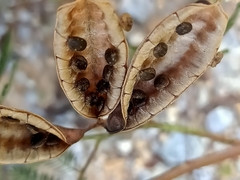
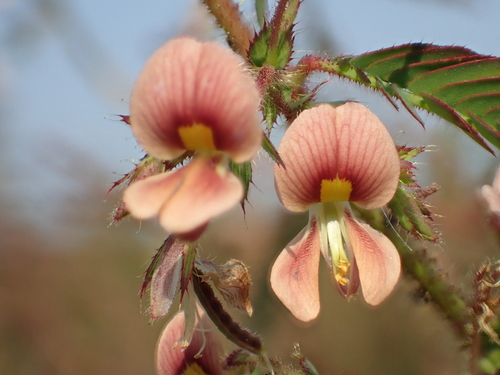
This plant is an annual or perennial herb growing up to 2 meters tall. The leaves are up to 7 centimeters long and have several pairs of linear to oblong leaflets. The sensitive leaves fold up when touched. The inflorescence is a raceme of flowers each up to a centimeter long. The flowers range in color from white to pinkish, orange, or purplish. The fruit is a curved legume pod up to 4 centimeters long made up of several jointed units, each unit containing a seed.
This species is widely used as a green manure or pasture plant throughout the tropical world.
Read more on Wikipedia · Text: Wikipedia, CC BY-SA 4.0
Aeschynomene americana es una especie de planta fanerógama perteneciente a la familia de las fabáceas. Se conoce con el nombre común de pega pega, pega ropa, antejuela, ronte, cujicillo, y dormilonga (Iberoamérica). Es originaria de América central, partes de Sudamérica, Indias Occidentales, y Florida.
Seguir leyendo en Wikipedia · Texto: Wikipedia, CC BY-SA 4.0
敏感合萌(学名:Aeschynomene americana)为豆科合萌属下的一个种。
在维基百科上阅读更多 · 文字:维基百科,CC BY-SA 4.0
Classification
| Kingdom | Plantae |
|---|---|
| Phylum | Tracheophyta |
| Class | Magnoliopsida |
| Order | Fabales |
| Family | Fabaceae |
| Genus | Aeschynomene |
In Suriname
Where it has been recorded
- Nickerie1
Districts with at least one record that has coordinates. Shaded districts have records.