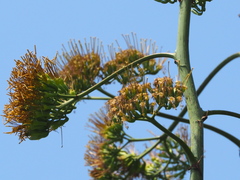
Sisal
Agave sisalana Perrine ex Engelm.
Names
| English | Sisal |
|---|---|
| Dutch | Sisal |
| Spanish | Henequén |
| Chinese | 剑麻 |
| Scientific name | Agave sisalana Perrine ex Engelm. |
About this species
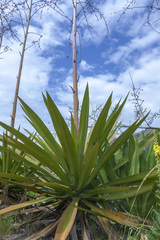
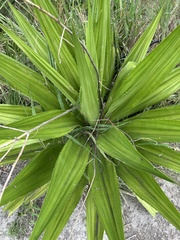
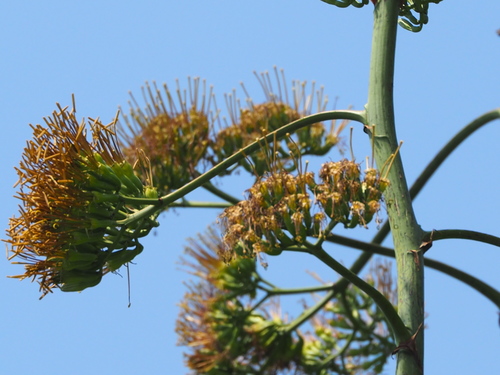
Sisal (Spanish: [siˈsal]; Agave sisalana) is a species of flowering plant native to southern Mexico, but widely cultivated and naturalized in many other countries. It yields a stiff leaf fiber used in making rope and various other products. The sisal fiber is traditionally used for rope and twine, and has many other uses, including cloth, footwear, hats, bags, carpets, geotextiles, and dartboards. It is also used as fiber reinforcements for composite fiberglass, rubber, and concrete products. Like other agaves, the pith of the leaves can be fermented and distilled to make mezcal.
Sisal has an uncertain native origin, but is thought to have originated in the Mexican state of Chiapas. Historically, sisal was used by the Aztecs and Maya for a crude fabric. It spread to other parts of the world in the 19th century, with Brazil becoming the major producer. Global sisal production in 2020 was 210,000 tons, with Brazil being the largest producer, followed by Tanzania, Kenya, Madagascar, China, and Mexico.
Read more on Wikipedia · Text: Wikipedia, CC BY-SA 4.0
Agave sisalana, de nombre común sisal, henequén o en maya yucateco, ki es una planta utilizada para fines comerciales, cultivada en regiones semiáridas. Se usa principalmente la fibra de las hojas, que se procesan especialmente para fabricar cuerdas, cordeles, sacos, telas y tapetes.
Seguir leyendo en Wikipedia · Texto: Wikipedia, CC BY-SA 4.0
剑麻(学名:Agave sisalana)又名菠萝麻、琼麻、衿麻,是天门冬科龙舌兰亚科龙舌兰属的一种纤维作物,原产墨西哥南部。1901年由美国领事达文生自夏威夷间接引进至台湾。剑麻常与同亚科的凤尾兰(学名:Yucca gloriosa)混淆。
在维基百科上阅读更多 · 文字:维基百科,CC BY-SA 4.0
Classification
| Kingdom | Plantae |
|---|---|
| Phylum | Tracheophyta |
| Class | Liliopsida |
| Order | Asparagales |
| Family | Asparagaceae |
| Genus | Agave |