Smalltail Shark
Carcharhinus porosus (Ranzani, 1839)
Names
| English | Smalltail Shark |
|---|---|
| Dutch | Kleinstaarthaai |
| Spanish | Tiburón poroso |
| Chinese | 小尾真鲨 |
| Scientific name | Carcharhinus porosus (Ranzani, 1839) |
About this species
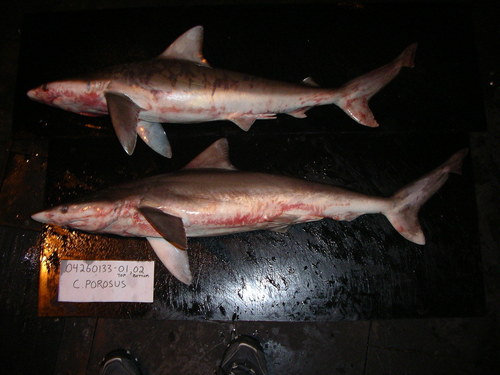
The smalltail shark (Carcharhinus porosus) is a species of requiem shark, and part of the family Carcharhinidae. It is found in the western Atlantic Ocean, from the northern Gulf of Mexico to southern Brazil. It inhabits shallow waters close to shore, particularly over muddy bottoms around estuaries. It tends to swim low in the water column and forms large aggregations segregated by sex. A slim species generally not exceeding 1.1 m (3.6 ft) in length, the smalltail shark has a rather long, pointed snout, a broad, triangular first dorsal fin, and a second dorsal fin that originates over the midpoint of the anal fin base. It is plain gray in color, without prominent markings on its fins.
The diet of the smalltail shark consists mainly of bony fishes such as croakers, while crustaceans, cephalopods, and smaller sharks and rays may also be consumed. It is viviparous, meaning the developing embryos are sustained by a placental connection. Females bear litters of two to 9 young on a biennial cycle, following a roughly 12-month gestation period.
Read more on Wikipedia · Text: Wikipedia, CC BY-SA 4.0
El tiburón poroso (Carcharhinus porosus) (Ranzani 1839) es una especie de elasmobranquio carcarriniforme perteneciente a la familia Carcharhinidae, placentario y vivíparo. Es un tiburón delgado y pequeño (alcanza en promedio 130 cm de largo), tiene un hocico largo, fusiforme y puntiagudo y grandes ojos redondos. La forma del cuerpo es fusiforme, de color gris, excepto en la parte ventral, que es de color "blanco sucio". Habita aguas costeras desde México al Brasil; el norte del Brasil (Pará y Maranhão) se considera el centro de abundancia de esta especie Su hábitat son zonas costeras bajas (< 84m), a lo largo de la plataforma continental, con fondos lodosos, en general de poca profundidad, como manglares, estuarios, lagunas en zonas cálidas, tropicales y subtropicales.
Seguir leyendo en Wikipedia · Texto: Wikipedia, CC BY-SA 4.0
小尾真鲨(学名:Carcharhinus porosus),为软骨鱼纲板鳃亚纲真鲨目真鲨科的其中一种,被IUCN列为极危保育类动物,意大利博物学家卡米洛·兰扎尼(Camillo Ranzani)在1839年出版的《博诺尼科学院新评论》卷中首次发表了对小尾真鲨的科学描述。他将本物种命名为Carcharias porosus,此模式标本是一只来自巴西的1.2米长的雄鱼。分布于西大西洋区,从墨西哥湾北部到巴西南部与乌拉圭(不包括加勒比海岛屿);东太平洋加利福尼亚湾到秘鲁海域,深度可达36米,本鱼体较细长,鼻子长而尖,眼大圆形且具瞬膜,嘴角处有短皱纹,双颚两侧各有13-15排牙齿(通常为上颚 14排牙,下颚牙齿13排牙),上牙很高,呈三角形,有很强的锯齿,向两侧倾斜地增加,下齿相对较窄且较直立,锯齿较细,五对鳃缝较短。胸鳍小呈镰刀形,尖端相对较尖,背鳍2个,成鱼的第一背鳍较宽,几乎形成等边三角形,顶端钝,起于胸鳍的后尖端,第二背鳍很小,起于臀鳍基部的中点,背鳍之间不存在脊,腹鳍很小,臀鳍后缘有一个深凹口,不对称的尾鳍具有坚固的下叶和较长的上叶,在尖端附近有一个腹侧切迹,身体呈纯灰色,下腹部呈白色,侧面有淡淡的浅色条纹,胸鳍、背鳍和尾鳍的尖端可能会变暗色,体长可达150公分。栖息在沙泥底质的大陆棚、河口、海湾,属肉食性,以硬骨鱼、小型鲨鱼、𫚉鱼、甲壳类和头足类等为食,胎生,全年均可繁殖,9月至11月为繁殖高峰,雌鱼一次可产下2 至9尾幼鱼,寿命可达12年。小尾真鲨对人类无害,通常是被刺网和延绳钓渔场偶然捕获,鱼肉、鱼翅可食用,肝油和软骨可入药,1980年代,该物种约占鲨鱼和𫚉鱼捕获量的43%,但此后已下降至17%左右。这种明显的下降被认为是由于捕捞量增加、捕获的幼鲨比例较高以及鲨鱼繁殖率低所致。因此,世界自然保护联盟将巴西的小尾真鲨评估为易危物种,尽管小尾真鲨表面上受到了保护,被列入2004年巴西官方濒危动物名录,但捕捞实际上仍然不受管理。
在维基百科上阅读更多 · 文字:维基百科,CC BY-SA 4.0
Classification
| Kingdom | Animalia |
|---|---|
| Phylum | Chordata |
| Class | Elasmobranchii |
| Order | Carcharhiniformes |
| Family | Carcharhinidae |
| Genus | Carcharhinus |
In Suriname
Where it has been recorded
- Brokopondo1
Districts with at least one record that has coordinates. Shaded districts have records.