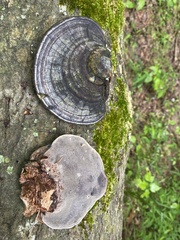
Southern Clam Shell
Fomes fasciatus (Sw.) Cooke
Names
| English | Southern Clam Shell |
|---|---|
| Dutch | — |
| Spanish | — |
| Chinese | — |
| Sranan Tongo | popolipo (general name for the group) |
| Scientific name | Fomes fasciatus (Sw.) Cooke |
About this species
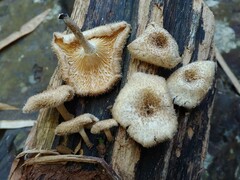
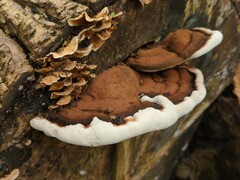
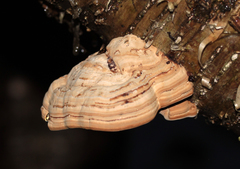
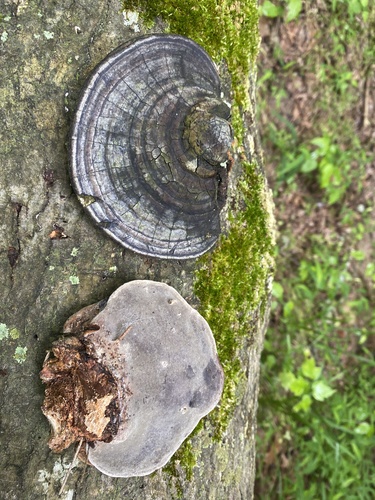
Fomes fasciatus, common name the Southern Clam Shell, is a pathogenic white rot fungus in the family Polyporaceae. It is found in the southeastern United States and Central and South America where it can be seen growing on various dead and living hardwood trees. It was first described by Swedish botanist Olof Swartz in Jamaica in 1788 as Boletus fasciatus. It was later transferred by Cooke to Fomes fasciatus in 1885. The genus name "Fomes" translates to tinder as its holotype was historically used to start fires and the specific epithet "fasciatus" translates to "banded", in reference to the bands of brown to grey and black colors that the top of its fruiting body displays.
F. fasciatus is in the same Genus as the better known Horse Hoof or Tinder Conk fungus Fomes fomentarius (F. excavatus), which was discovered with the 5,000 year old body of Otzi the Iceman in the Italian Alps. It has a similar morphology to F. fomentarius and has likely been confused in identifications given that both species overlap in physical features and variances.
Read more on Wikipedia · Text: Wikipedia, CC BY-SA 4.0
Classification
| Kingdom | Fungi |
|---|---|
| Phylum | Basidiomycota |
| Class | Agaricomycetes |
| Order | Polyporales |
| Family | Polyporaceae |
| Genus | Fomes |
In Suriname
Where it has been recorded
- Sipaliwini4
- Brokopondo1
- Paramaribo1
Districts with at least one record that has coordinates. Shaded districts have records.