
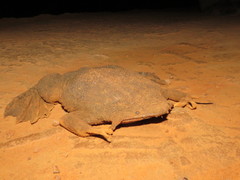
About this species
The common Surinam toad, the Suriname toad, or star-fingered toad (Pipa pipa), is a fully-aquatic species of frog, in the family Pipidae, with a widespread range across much of tropical South America and the island of Trinidad. The females of this species are well-known for "incubating" their eggs on their backs, in honeycomb-like depressions directly within the skin, releasing fully-formed froglets after a period of 4–5 months. Pipa pipa is an ambush predator, lying in-wait underwater for prey to inevitably wander too close, swiftly inhaling the unsuspecting creature using suction feeding. Additionally, the Surinam toad's rather flat body shape, combined with rather dark, dull coloration, serves as effective camouflage in the murky waters they inhabit, mimicking a dead leaf or piece of rotting wood as they await their next meal.
Read more on Wikipedia · Text: Wikipedia, CC BY-SA 4.0
El sapo de Surinam (Pipa pipa), también conocido como sapo pipa, cururú, aparo, rana de celdillas, rana tablacha, sapo chola, o sapo de celdas, es un anfibio anuro que habita en regiones tropicales y subtropicales de Sudamérica y en la Isla Trinidad. Tiene el cuerpo achatado y la cabeza plana y triangular. Es de color gris verdoso con la parte inferior del cuerpo de un tono más pálido. Vive en pantanos, marismas, aguas turbias y fangosas. Está altamente adaptado a una vida acuática. Posee extremidades traseras poderosas que le ayudan a nadar y es una especie relativamente común.
La rana común de celdillas, con un tamaño de 12 a 20 cm, tiene una cabeza triangular, ojos grandes con pupilas redondeadas, y las narinas al final de dos tubos estrechos en el hocico. El cuerpo es plano, de color marrón o verde oliva, y cubierto por muchos tubérculos dándole el aspecto general de una hoja muerta. Las extremidades anteriores son cortas y débiles y las extremidades posteriores son largas, fuertes y palmeadas.
Seguir leyendo en Wikipedia · Texto: Wikipedia, CC BY-SA 4.0
负子蟾(学名:Pipa pipa),又名苏利负子蟾、苏利南蟾蜍、苏利南爪蟾,为负子蟾科负子蟾属下的一个种。
个体粗壮,体长约10厘米,无舌,脚趾有蹼,常年生活在水中。
产卵前,雌蟾背部的皮肤软得像海绵。其卵在母体的背上小窝里生长,而母体背上的皮肤会围绕在卵的周围,为卵提供一个“家”。卵直接发育成小蟾蜍,然后从母体背上“喷射”出来,离开母体。而母体随后会蜕掉千疮百孔的皮肤,并独自生活。
在维基百科上阅读更多 · 文字:维基百科,CC BY-SA 4.0
Classification
| Kingdom | Animalia |
|---|---|
| Phylum | Chordata |
| Class | Amphibia |
| Order | Anura |
| Family | Pipidae |
| Genus | Pipa |
In Suriname
Where it has been recorded
- Paramaribo49
- Sipaliwini31
- Para23
- Commewijne13
- Saramacca6
- Brokopondo1
- Marowijne1
- Nickerie1
Districts with at least one record that has coordinates. Shaded districts have records.
Records by month
All years combined.
