Mallow family: kapok, cacao & okra
Upland Cotton
Gossypium hirsutum L.
Names
| English | Upland Cotton |
|---|---|
| Dutch | Behaarde katoen |
| Spanish | Algodón mexicano |
| Chinese | 陆地棉 |
| Scientific name | Gossypium hirsutum L. |
About this species
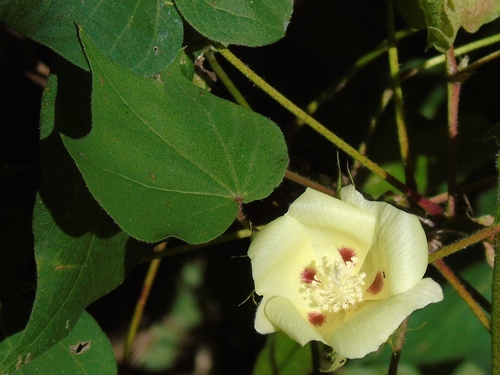
Gossypium hirsutum, also known as upland cotton or Mexican cotton, is the most widely planted species of cotton in the world. Globally, about 90% of all cotton production is of cultivars derived from this species. In the United States, the world's largest exporter of cotton, it constitutes approximately 95% of all cotton production. It is native from Mexico to Ecuador and northeast Brazil, the Leeward Antilles in the Caribbean and the Pacific (Fiji, Marianas, Polynesia and Revillagigedo Islands).
It is believed that Gossypium hirsutum was created when a wild Mexican cotton species mixed with the wild African species Gossypium herbaceum around 5–10 million years ago, producing a hybrid species with four pairs of chromosomes (totaling 52 chromosomes) via polyploidy.
The original native range of Gossyypium hirsutum centers on the Yucatán Peninsula, where researchers have found the greatest genetic diversity among samples taken from the wild.
Read more on Wikipedia · Text: Wikipedia, CC BY-SA 4.0
Gossypium hirsutum, con el nombre común de algodón de tierras altas o algodón mexicano, es la especie más ampliamente plantada de algodón en los Estados Unidos, constituyendo el 95% de toda la producción de algodón. Originario del continente americano, específicamente de México, esta especie representa el 90% de toda la producción de todo el mundo. En náhuatl, es conocido como ichcatel y los mayas lo conocen como taman.
Seguir leyendo en Wikipedia · Texto: Wikipedia, CC BY-SA 4.0
陆地棉(学名:Gossypium hirsutum)为锦葵科棉属下的一个种。
在维基百科上阅读更多 · 文字:维基百科,CC BY-SA 4.0
Classification
| Kingdom | Plantae |
|---|---|
| Phylum | Tracheophyta |
| Class | Magnoliopsida |
| Order | Malvales |
| Family | Malvaceae |
| Genus | Gossypium |
In Suriname
Where it has been recorded
- Paramaribo1
Districts with at least one record that has coordinates. Shaded districts have records.