Veined Tree Frog
Trachycephalus typhonius (Linnaeus, 1758)
Names
| English | Veined Tree Frog |
|---|---|
| Dutch | Gewone melkboomkikker |
| Spanish | Rana arborícola lechosa |
| Chinese | — |
| Sranan Tongo | todo (general name for the group) |
| Scientific name | Trachycephalus typhonius (Linnaeus, 1758) |
About this species
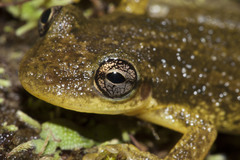
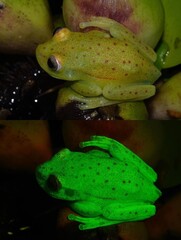
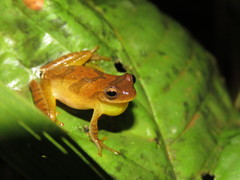
The veined tree frog (Trachycephalus typhonius), or common milk frog, is a species of frog in the family Hylidae.
This species was previously within the genus Phrynohyas, which was recently synonymized with Trachycephalus.
It is found in Central and South America.
Its natural habitats are subtropical or tropical dry forest, subtropical or tropical moist lowland forest, subtropical or tropical moist shrubland, subtropical or tropical dry lowland grassland, rivers, intermittent rivers, freshwater lakes, freshwater marshes, intermittent freshwater marshes, arable land, pastureland, plantations, rural gardens, urban areas, heavily degraded former forest, water storage areas, and ponds. The veined tree frog is nocturnal, and can typically be found in tree branches and in areas with large amounts of vegetation. This frog is one of several other tree frogs in the family Hylidae that secrete a toxic substance from their skin that produces extreme irritation and pain when in contact with mucosal membrane surfaces.
The veined tree frog has been observed being eaten by a mantis.
Read more on Wikipedia · Text: Wikipedia, CC BY-SA 4.0
La rana arborícola lechosa o rana lechera común (Trachycephalus typhonius) es una especie de anfibio de la familia Hylidae. Alcanza una longitud hocico cloaca de 8 cm, las hembras son más grandes que los machos. Sus ojos son grandes con pupilas elípticas bordeadas de flecos dorados. El color del cuerpo es muy variado, frecuentemente tienen manchas de color café bordeadas de negro sobre un fondo gris o café claro, el vientre es claro sin manchas. Su piel es granular y posee glándulas que secretan una sustancia tóxica, similar a una resina blanca y pegajosa que aturde a sus depredadores. En los humanos esta sustancia solamente causa irritación al tener contacto con los ojos o zonas sensibles del cuerpo. Se distribuye desde el norte de Sonora y Tamaulipas en México, hasta el norte de Argentina.
Seguir leyendo en Wikipedia · Texto: Wikipedia, CC BY-SA 4.0
Classification
| Kingdom | Animalia |
|---|---|
| Phylum | Chordata |
| Class | Amphibia |
| Order | Anura |
| Family | Hylidae |
| Genus | Trachycephalus |
In Suriname
Where it has been recorded
- Sipaliwini51
- Brokopondo11
- Commewijne10
- Para6
- Wanica4
- Marowijne3
- Nickerie2
- Paramaribo1
Districts with at least one record that has coordinates. Shaded districts have records.
Records by month
All years combined.