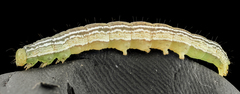
Velvetbean Caterpillar Moth
Anticarsia gemmatalis Hübner, 1818
Names
| English | Velvetbean Caterpillar Moth |
|---|---|
| Dutch | — |
| Spanish | Oruga de las leguminosas |
| Chinese | 大豆夜蛾 |
| Sranan Tongo | kapelka (general name for the group) |
| Scientific name | Anticarsia gemmatalis Hübner, 1818 |
About this species
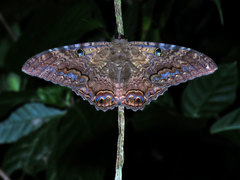
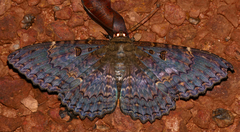
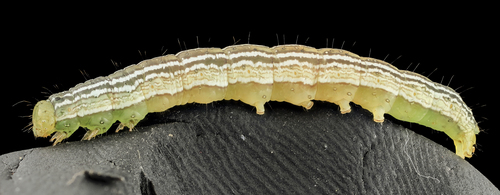
Anticarsia gemmatalis is a tropical species of caterpillar and moth that migrates north each season. The species can commonly be found in the Gulf states, north as far as Wisconsin. The adults have wings that are grayish brown, crossed with brown or black zigzag lines. The caterpillars are black or green, with narrow lighter stripes on the back and sides. They spit out a brownish substance, spring into the air and wriggle a lot when they are disturbed. The species eats velvet beans, peanut, soybeans, cotton, kudzu, alfalfa, cowpeas, horse beans, snap beans, lima beans, and coffeeweeds. Its common name is velvetbean caterpillar and velvetbean moth.
Egg viability was highest at 25 °C (77 °F) and adaptation to higher temperatures did not occur over a three generation observation. This suggests global warming will reduce A. gemmatalis losses on soybeans in tropical areas that are already at 25 °C (77 °F) but increase predation on soybeans in areas currently below that temperature, thus in fact only shifting the affected area.
Read more on Wikipedia · Text: Wikipedia, CC BY-SA 4.0
Anticarsia gemmatalis is een vlinder uit de familie van de spinneruilen (Erebidae). De wetenschappelijke naam van de soort is voor het eerst geldig gepubliceerd in 1818 door Hübner.
Lees verder op Wikipedia · Tekst: Wikipedia, CC BY-SA 4.0
La oruga de las leguminosas (Anticarsia gemmatalis) son una especie tropical de lepidópteros ditrisios de la familia Noctuidae. Habita en el noreste de México, donde se le conoce como gusano saltarín, los estados del Golfo y en lugares tan lejanos como Wisconsin. Los ejemplares adultos tienen alas que son grisáceas con líneas negras o café en forma de zigzag. Las orugas son de color negro o verde con rayas claras en la parte dorsal y lateral.
Estos insectos salivan una sustancia marrón, vuelan repentinamente y se estremecen mucho cuando son molestados. Se alimenta de frijol terciopelo, maní, soya, algodón, kudzu, alfalfa, caupí, habas, judías de lima y de cassia (Senna obtusifolia).
El murciélago Tadarida brasiliensis sirve como control biológico de esta especie.
Seguir leyendo en Wikipedia · Texto: Wikipedia, CC BY-SA 4.0
Classification
| Kingdom | Animalia |
|---|---|
| Phylum | Arthropoda |
| Class | Insecta |
| Order | Lepidoptera |
| Family | Erebidae |
| Genus | Anticarsia |
In Suriname
Where it has been recorded
- Paramaribo3
- Commewijne1
Districts with at least one record that has coordinates. Shaded districts have records.