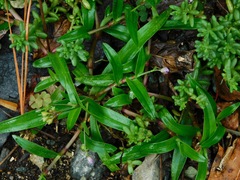
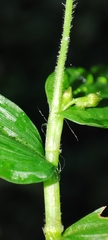
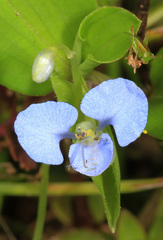
Virginia Dayflower
Commelina virginica L.
Names
| English | Virginia Dayflower |
|---|---|
| Dutch | — |
| Spanish | Hierba del pollo |
| Chinese | 维吉尼亚鸭跖草 |
| Scientific name | Commelina virginica L. |
About this species
Commelina virginica, commonly known as the Virginia dayflower, is a perennial herbaceous plant in the dayflower family. It is native to the mideastern and southeastern United States, where it is typical of wet soils. While most members of the genus have thin, fibrous roots, the Virginia dayflower is unusual for its genus in having a perennial rhizome. The plant was first described by Carl Linnaeus in his 1762 publication of the second edition of Species Plantarum. A phylogenetic study based on the nuclear ribosomal DNA region 5S NTS and the chloroplast region trnL-trnF, two commonly used gene regions for determining relationships, suggested that Commelina virginica is most closely related to two African species, namely Commelina capitata and Commelina congesta. However, the statistical support for this result was low. Morphologically speaking the supposedly related species do share some unique traits. C. virginica and C. capitata have red hairs at the top of their leaf sheaths, an unusual character in the genus, while C. virginica and C.
Read more on Wikipedia · Text: Wikipedia, CC BY-SA 4.0
Commelina virginica es una planta perenne herbácea de la familia Commelinaceae.
Seguir leyendo en Wikipedia · Texto: Wikipedia, CC BY-SA 4.0
耳苞鸭跖草(学名:Commelina auriculata),又名蓬莱鸭跖草、耳叶鸭跖草,为鸭跖草科鸭跖草属的植物。分布在大洋洲、印度尼西亚、日本、台湾岛以及中国大陆的澳门、广东、福建等地,见于低海拔的丘陵丛林中或山沟水边,目前尚未由人工引种栽培。
在维基百科上阅读更多 · 文字:维基百科,CC BY-SA 4.0
Classification
| Kingdom | Plantae |
|---|---|
| Phylum | Tracheophyta |
| Class | Liliopsida |
| Order | Commelinales |
| Family | Commelinaceae |
| Genus | Commelina |
In Suriname
Where it has been recorded
- Paramaribo1
Districts with at least one record that has coordinates. Shaded districts have records.