Western Honey Bee
Apis mellifera Linnaeus, 1758
Names
| English | Western Honey Bee |
|---|---|
| Dutch | Europese honingbij |
| Spanish | Abeja europea |
| Chinese | 西方蜜蜂 |
| Scientific name | Apis mellifera Linnaeus, 1758 |
About this species
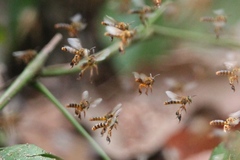
The western honey bee (Apis mellifera) is the most common of the 7–12 species of honey bees worldwide. The genus name Apis is Latin for 'bee', and mellifera is the Latin for 'honey-bearing' or 'honey-carrying', referring to the species' production of honey.
Like all honey bee species, the western honey bee is eusocial, creating colonies with a single fertile female (or "queen"), many normally non-reproductive females or "workers", and a small proportion of fertile males or "drones". Individual colonies can house tens of thousands of bees. Colony activities are organized by complex communication between individuals, through both pheromones and the waggle dance.
The western honey bee was one of the first domesticated insects, and it is the primary species maintained by beekeepers to this day for both its honey production and pollination activities. With human assistance, the western honey bee now occupies every continent except Antarctica. Western honey bees are threatened by pests and diseases, especially the Varroa mite and colony collapse disorder.
Read more on Wikipedia · Text: Wikipedia, CC BY-SA 4.0
La abeja europea (Apis mellifera), también conocida como abeja doméstica o abeja melífera o apia (en pequeñas regiones del norte argentino) es una especie de himenóptero apócrito de la familia Apidae. Es la especie de abeja con mayor distribución en el mundo. Originaria de Europa, África y parte de Asia, fue introducida en América y Oceanía. La abeja fue clasificada por Carlos Linneo en 1758. A partir de entonces, numerosos taxónomos describieron variedades geográficas o subespecies que, en la actualidad, superan las treinta razas. Actualmente la población de abejas en algunos países se halla en franco retroceso sin que se conozca de manera clara las causas, que bien podría ser un cúmulo de diversos factores. Son importantes en la polinización de un número de cosechas.
Seguir leyendo en Wikipedia · Texto: Wikipedia, CC BY-SA 4.0
西方蜜蜂,西洋蜜蜂,或欧洲蜜蜂(学名:Apis mellifera)是全世界 7-12 种蜜蜂中最常见的一种。其 Apis 是拉丁文的蜜蜂,种小名 mellifera 为「带有蜜糖」。卡尔·林奈(Carolus Linnaeus)后来发现蜜糖其实是蜜蜂制造的,故曾想更正其种小名为mellifica,即「制造蜜糖」的意思。不过根据《国际动物命名法规》,首先命名的学名才是有效的。
与所有蜜蜂物种一样,西方蜜蜂是群居性的,它们会形成由单一可育雌性(或「蜂王」)、许多通常不具有生殖能力的雌性或「工蜂」以及一小部分可育雄性或「雄蜂」组成的蜂群。单一蜂群可容纳数万只蜜蜂。群体活动是透过个体之间透过信息素和舞蹈语言进行的复杂交流来组织的。
西部蜜蜂是最早驯化的昆虫之一,也是养蜂人至今维持的主要物种,用于生产蜂蜜和授粉活动。在人类的帮助下,西方蜜蜂现在已占领除南极洲以外的所有大陆;但有迹象表明,该物种在欧洲的野外即使没有灭绝,也是稀有物种。
西方蜜蜂是科学研究中重要的模式生物,特别是在社会演化、学习和记忆领域;它们也用于农药毒性研究,特别是透过花粉的毒性研究,以评估商业农药的非目标影响。此外,西方蜜蜂的基因组于2006年被定序与分析,成为第四种完成基因组定序的昆虫。
在维基百科上阅读更多 · 文字:维基百科,CC BY-SA 4.0
Classification
| Kingdom | Animalia |
|---|---|
| Phylum | Arthropoda |
| Class | Insecta |
| Order | Hymenoptera |
| Family | Apidae |
| Genus | Apis |
In Suriname
Where it has been recorded
- Paramaribo15
- Sipaliwini11
- Brokopondo3
- Para3
- Commewijne2
- Wanica1
Districts with at least one record that has coordinates. Shaded districts have records.
Records by month
All years combined.