Whale Shark
Rhincodon typus Smith, 1828
Names
| English | Whale Shark |
|---|---|
| Dutch | Walvishaai |
| Spanish | Tiburón ballena |
| Chinese | 鲸鲨 |
| Scientific name | Rhincodon typus Smith, 1828 |
About this species
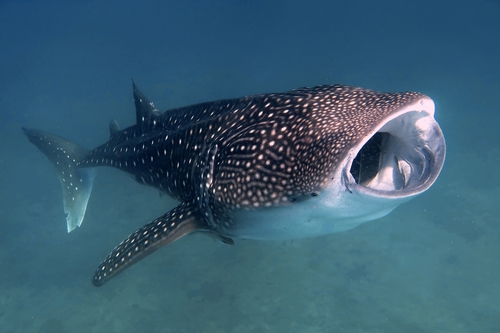
The whale shark (Rhincodon typus) is a slow-moving, filter-feeding carpet shark and the largest known extant fish species. An individual with a length of 18.8 m (61.7 ft) has been considered the largest reliably recorded. The whale shark holds many records for size in the animal kingdom, most notably being by far the largest living non-cetacean animal. It is the only living species of the genus Rhincodon and the only extant member of the family Rhincodontidae, which belongs to the subclass Elasmobranchii in the class Chondrichthyes. Before 1984, it was classified as Rhiniodon into Rhinodontidae. An extinct species, Rhincodon ferriolensis, was described in Europe (probably in Spain), in the Late Burdigalian stage.
The whale shark is an active filter feeder, primarily consuming plankton, krill, fish eggs, and small schooling fish such as sardines and anchovies. The shark can process over 6,000 liters of water per hour through its specialized sieve-like gill pads.
Read more on Wikipedia · Text: Wikipedia, CC BY-SA 4.0
El tiburón ballena (Rhincodon typus) es una especie de elasmobranquio orectolobiforme, único miembro de la familia Rhincodontidae y del género Rhincodon; es el pez existente más grande del mundo, con aproximadamente 15m de longitud. Presenta una alimentación por filtración. Habita en aguas cálidas tropicales y subtropicales. Se ha sugerido que habita en la Tierra desde hace 60 millones de años. En México se considera amenazado.
El primer ejemplar identificado medía 4,6 metros de longitud y fue arponeado y capturado en las costas de Table Bay, Sudáfrica, en 1828. El espécimen fue vendido por 6 £, y su holotipo se muestra en el Museo de Historia Natural de París. La primera cita científica fue dada al año siguiente por Andrew Smith, un médico militar vinculado al ejército británico, que se encontraba estacionado en Ciudad del Cabo. En 1849 publicó una descripción más detallada de la especie. Se le asignó el nombre de "tiburón ballena" debido a la fisiología del pez, ya que se trata de un tiburón pero posee un tamaño comparable al de una ballena.
Seguir leyendo en Wikipedia · Texto: Wikipedia, CC BY-SA 4.0
鲸鲨(学名:Rhincodon typus),又名鲸鲛、豆腐鲨(台罗:tāu-hū-sua)、大戆鲨(台罗:tuā-gōng-sua)、戆仔鲨(台罗:gōng-á-sua),是目前世界上现存体型最大的鱼类,属于软骨鱼纲须鲨目鲸鲨科。截至目前为止,生物学家实际记录到的最大尺寸为12.65公尺长,21.5公吨重,其他体型更大的个体报告并未确认。鲸鲨为鲸鲨科(Rhincodontidae,1984年前称为Rhinodontes)及鲸鲨属中唯一的成员。
鲸鲨生活在热带海域中,寿命可达70年至100年。鲸鲨具有非常宽大的嘴巴,是一种滤食动物,主要捕食小型动植物(包括浮游生物),但英国广播公司的自然纪录片《地球脉动》曾拍摄到一条鲸鲨正在捕食一群小型鱼类。
生物学家在1828年4月根据一条南非桌湾捕获到的个体,首次辨认出鲸鲨。开普敦英国军医与动物学家安德鲁·史密斯(Andrew Smith)在隔年进一步描述这条鲸鲨的特征,然后在1849年公布更多有关鲸鲨的细节。「鲸鲨」这个名称来自鱼类生物学,表示鲸鲨的体型与鲸鱼一样庞大,而且牠们跟许多鲸鱼同样都是滤食动物。
鲸鲨栖息在热带海域,大约分布在南北纬30度的范围,每年春天会迁移到西澳大利亚州中部的大陆棚海域,这里的宁格罗珊瑚礁(Ningaloo Reef)为鲸鲨提供了丰富的食物来源(浮游生物)。鲸鲨以浮游生物为主食,牠们会在一些海域进行季节性的觅食活动,例如西澳大利亚宁歌路珊瑚礁、宏都拉斯、菲律宾董索与八打雁(Batangas)、坦尚尼亚奔巴岛、马菲亚岛与桑吉巴、印度大卡吉盐沼地、墨西哥尤卡坦州穆赫雷斯岛及奥尔沃克斯岛、马达加斯加贝岛、印度尼西亚乌戎库隆国家公园等地,以色列埃拉特也有非常少数的鲸鲨聚集。
虽然鲸鲨通常出现在近海地区,不过人类也曾经在沿岸、潟湖、珊瑚礁、河口与运河发现牠们的踪影。人类也曾经在700公尺深的海域发现过鲸鲨。鲸鲨通常单独活动,除非在食物丰富的地区觅食,否则牠们很少群聚在一起。雄性鲸鲨的活动范围比雌性更大,因为雌性鲸鲨比较偏好出现在特定的地点。2011年,生物学家在墨西哥尤卡坦州沿岸发现一群鲸鲨聚集捕食小鲔,牠们的数量超过400条,是人类有史以来记录到最多鲸鲨聚集的一次。
在维基百科上阅读更多 · 文字:维基百科,CC BY-SA 4.0
Classification
| Kingdom | Animalia |
|---|---|
| Phylum | Chordata |
| Class | Elasmobranchii |
| Order | Orectolobiformes |
| Family | Rhincodontidae |
| Genus | Rhincodon |