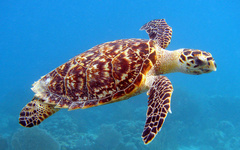
Hawksbill Sea Turtle
Eretmochelys imbricata (Linnaeus, 1766)
Names
| English | Hawksbill Sea Turtle |
|---|---|
| Dutch | Karetschildpad |
| Spanish | Tortuga carey |
| Chinese | 玳瑁 |
| Sranan Tongo | sekrepatu (general name for the group) |
| Scientific name | Eretmochelys imbricata (Linnaeus, 1766) |
About this species
The hawksbill sea turtle (Eretmochelys imbricata) is a critically endangered sea turtle belonging to the family Cheloniidae. It is the only extant species in the genus Eretmochelys. The species has a global distribution that is largely limited to tropical and subtropical marine and estuary ecosystems.
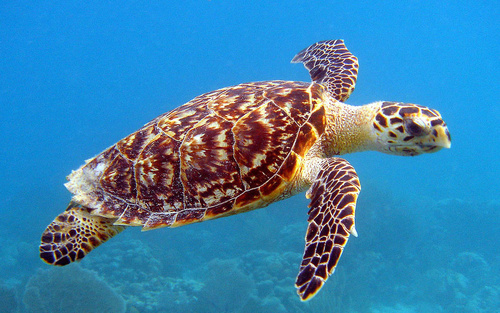
The appearance of the hawksbill is similar to that of other sea turtles. In general, it has a flattened body shape, a protective carapace, and flipper-like limbs, adapted for swimming in the open ocean. E. imbricata is easily distinguished from other sea turtles by its sharp, curving beak with prominent tomium, and the saw-like appearance of its shell margins. Hawksbill shells slightly change colors, depending on water temperature. While this turtle lives part of its life in the open ocean, it spends more time in shallow lagoons and coral reefs.
The World Conservation Union classifies E. imbricata as critically endangered, primarily as a result of human fishing practices. Hawksbill shells were the primary source of tortoiseshell material used for decorative purposes.
Read more on Wikipedia · Text: Wikipedia, CC BY-SA 4.0
La tortuga carey o parape (Eretmochelys imbricata) es una especie de tortuga marina de la familia de los quelónidos. Es la única especie del género Eretmochelys. Existen dos subespecies, Eretmochelys imbricata imbricata que se puede encontrar en el océano Atlántico y Eretmochelys imbricata bissa, localizada en la región Indo-Pacífico.
Su aspecto es similar al de otras tortugas marinas. Tiene un cuerpo plano, un caparazón protector, y sus extremidades en forma de aletas están adaptadas para nadar en mar abierto. Se distingue fácilmente de otras tortugas marinas por su pico puntiagudo y curvo con una prominente mandíbula superior (tomium) y por los bordes en forma de sierra de su caparazón. Aunque la tortuga pasa parte de su vida en mar abierto, se la encuentra más frecuentemente en lagunas poco profundas y arrecifes de coral, donde encuentra fácilmente su presa preferida, las esponjas de mar.
Seguir leyendo en Wikipedia · Texto: Wikipedia, CC BY-SA 4.0
玳(dài)瑁(mào)(学名:Eretmochelys imbricata)是海龟科的海龟,是玳瑁属下唯一一种爬行动物。,又名瑇瑁、蝳蝐、瑇玳、文甲、鹰嘴海龟、十三鲮龟、十三鳞、十三棱龟、明玳瑁、千年龟,简称玳,分为太平洋玳瑁(Eretmochelys imbricata bissa)和大西洋玳瑁(Eretmochelys imbricata imbricata)两种亚种。此物种分布非常广泛,其中太平洋玳瑁分布于印太海域,大西洋玳瑁分布于大西洋中。该物种的模式产地在美洲和亚洲的海域。
玳瑁的外形与其他海龟大致相似,都有扁平躯体、保护背甲、以及适于划水的桨状鳍足,而玳瑁最明显的特点是其鹰喙般的嘴,以及躯体后部锯齿般的缘盾。虽然玳瑁在海域中分布广泛,最主要的生活区是浅水礁湖和珊瑚礁区,珊瑚礁中的许多洞穴和深谷给它提供休息的地方,珊瑚礁中还生活着玳瑁最主要的食物——海绵。部分海绵物种对其他脊椎动物具有毒性,并且带有大量无法消化的二氧化硅骨针,尽管如此,玳瑁仍是少数以海绵为主食的动物,也是唯一以海绵为主食的海龟。玳瑁的食物还包括栉水母、水母、海葵、虾蟹和贝类等无脊椎动物以及鱼类和海藻。
玳瑁的甲壳上有美丽而又色彩斑斓的花纹,是一种名贵的宝石,可作为首饰、雕塑等饰品的原材料,高贵典雅,有祥瑞幸福、健康长寿的象征,享有“海金”之称。玳瑁工艺在中国已有上千年的历史,工艺水平在唐代已达顶峰,日本的玳瑁工艺也受到了中国很大的影响。正是由于人类对玳瑁的过度需求,导致玳瑁在世界范围内的数量持续减少,已有灭绝的危险,目前两种玳瑁亚种的保护现状均已由世界自然保护联盟(IUCN)评为极危状态。一些国家和地区,如中国大陆和日本,常会猎取玳瑁、挖其巢穴以食用它的肉和蛋,因此玳瑁的保护有很大困难。目前玳瑁受到《濒危野生动植物种国际贸易公约》的保护,很多国家已禁止猎捕玳瑁,也禁止进出口玳瑁产品。
在维基百科上阅读更多 · 文字:维基百科,CC BY-SA 4.0
Classification
| Kingdom | Animalia |
|---|---|
| Phylum | Chordata |
| Class | Testudines |
| Family | Cheloniidae |
| Genus | Eretmochelys |
In Suriname
Records by month
All years combined.