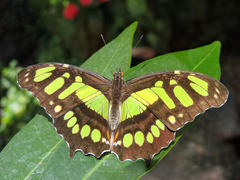
Malachite
Siproeta stelenes Linnaeus, 1758
Names
| English | Malachite |
|---|---|
| Dutch | Malachietvlinder |
| Spanish | Camuflada verde |
| Chinese | 绿帘蛱蝶 |
| Sranan Tongo | kapelka (general name for the group) |
| Scientific name | Siproeta stelenes Linnaeus, 1758 |
About this species
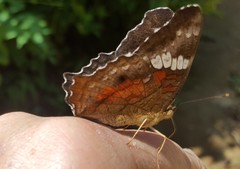
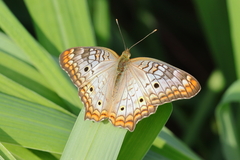
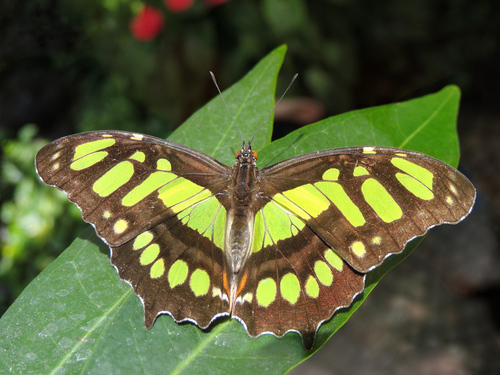
Siproeta stelenes (malachite) is a Neotropical brush-footed butterfly (family Nymphalidae). The malachite has large wings that are black and brilliant green or yellow-green on the upperside and light brown and olive green on the underside. It is named for the mineral malachite, which is similar in color to the bright green on the butterfly's wings. Typically, the wingspread is between 8.5 and 10 cm (3.3 and 3.9 in). The malachite is found throughout Central and northern South America, where it is one of the most common butterfly species. Its distribution extends as far north as southern Texas and the tip of Florida, to Cuba as subspecies S. s. insularis (Holland, 1916), and S. s. biplagiata, and south to Brazil.
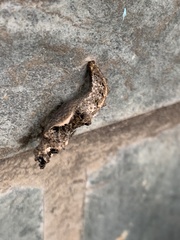
Adults feed on flower nectar, rotting fruit, dead animals, and bat dung. Females lay eggs on the new leaves of plants in the family Acanthaceae, especially Ruellia, Blechum and Plantago. The larvae are horned, spiny, black caterpillars with red markings, The pupal stage is green, with sharp, gold spines that can puncture predators.
Read more on Wikipedia · Text: Wikipedia, CC BY-SA 4.0
La camuflada verde o malaquita (Siproeta stelenes) es una mariposa neotropical (familia Nymphalidae). La camuflada verde tiene grandes alas que son de color negro y brillante de color verde o amarillo-verde en el haz de luz y de color marrón y verde oliva en la parte inferior. El nombre malaquita viene del mineral malaquita, que es similar en color al verde brillante en las alas de la mariposa. Por lo general, la extensión de alas es de entre 8,5 y 10 cm (3,3 y 3,9 pulgadas). La camuflada verde se encuentra en toda América Central y el norte de América del Sur, donde es una de las especies más comunes de mariposa. Su distribución se extiende por el norte hasta el sur de Texas y la punta de la Florida, a Cuba como subespecies de S. s. insularis (Holland, 1916), y S. s. biplagiata, y el sur de Brasil.
Los adultos se alimentan de néctar de las flores, frutos podridos, animales muertos, y el estiércol de murciélagos (Chiroptera). Las hembras ponen los huevos en las hojas nuevas de plantas de la familia Acanthaceae, especialmente Ruellia.
Seguir leyendo en Wikipedia · Texto: Wikipedia, CC BY-SA 4.0
Classification
| Kingdom | Animalia |
|---|---|
| Phylum | Arthropoda |
| Class | Insecta |
| Order | Lepidoptera |
| Family | Nymphalidae |
| Genus | Siproeta |
In Suriname
Where it has been recorded
- Brokopondo34
- Commewijne15
- Sipaliwini11
- Paramaribo3
- Para2
Districts with at least one record that has coordinates. Shaded districts have records.
Records by month
All years combined.