Mexican Culantro
Eryngium foetidum L.
Names
| English | Mexican Culantro |
|---|---|
| Dutch | Stinkdistel |
| Spanish | Cilantro cimarrón |
| Chinese | 越南香菜 |
| Scientific name | Eryngium foetidum L. |
About this species
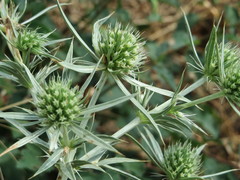
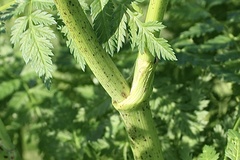
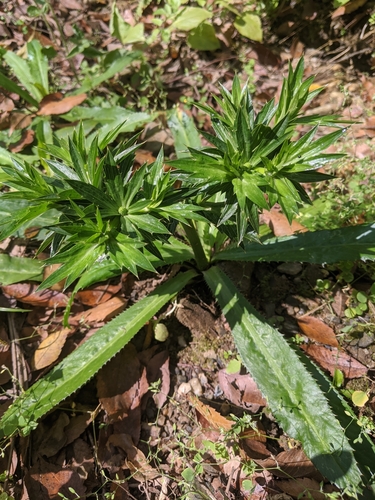
Eryngium foetidum is a tropical perennial herb in the family Apiaceae. Common names include culantro (Costa Rica and Panama) ( or ), cimarrón, recao (Puerto Rico), chardon béni (Martinique), Mexican coriander, samat, ban dhaniya, long coriander, wide coriander, Burmese coriander, sawtooth coriander, Shadow Beni (Trinidad and Tobago), and ngò gai (Vietnam). It is native to Mexico, the Caribbean, and Central and South America, but is cultivated worldwide, mostly in the tropics as a perennial, but sometimes in temperate climates as an annual. In India it is called "Mandhonia", specifically in the Northeast.
In the United States, the common name culantro sometimes causes confusion with cilantro, a common name for the leaves of Coriandrum sativum (also in Apiaceae but in a different genus), of which culantro is said to taste like a stronger version.
Read more on Wikipedia · Text: Wikipedia, CC BY-SA 4.0
Eryngium foetidum, llamada popularmente cilantro, cilantro habanero, cilantro de monte, cilantrón, cilantro camino, pioresnada, chicoria (norte de Nicaragua), chillangua (Ecuador y Colombia), o culantro coyote (Costa Rica), recao (Puerto Rico), culantro (Panamá), Culantro de pata (Honduras), alcapate (El Salvador y México), alcapa y samat (Guatemala) o sacha culantro(Perú) . En varios países de América para distinguirla de la más tradicional Coriandrum sativum, es una hierba comestible tropical perenne y anual de la familia Apiaceae. Es nativa de América tropical donde crece de forma silvestre, pero se cultiva en todo el mundo tropical. Es utilizada como condimento por su olor y sabor característico, muy semejante al Coriandrum sativum o cilantro europeo pero más fuerte y de hojas significativamente más duras.
Seguir leyendo en Wikipedia · Texto: Wikipedia, CC BY-SA 4.0
刺芹(学名:Eryngium foetidum),又名假芫荽、节节花、野香草(广东)、假香荽(广西)、缅芫荽、大香菜(云南)、刺芫荽,为伞形科刺芹属的植物。分布于安的列斯群岛、亚洲、南美、非洲、中美以及中国大陆的广东、云南、贵州、广西等地,生长于海拔100米至1,540米的地区,常生于路旁、丘陵、山地林下以及沟边等湿润处。加勒比地区的人们会用它来腌菜及治疗烧伤、发烧、疟疾、癫痫等。
在维基百科上阅读更多 · 文字:维基百科,CC BY-SA 4.0
Classification
| Kingdom | Plantae |
|---|---|
| Phylum | Tracheophyta |
| Class | Magnoliopsida |
| Order | Apiales |
| Family | Apiaceae |
| Genus | Eryngium |
In Suriname
Where it has been recorded
- Sipaliwini8
- Paramaribo5
- Brokopondo3
- Marowijne2
- Para2
- Commewijne1
- Saramacca1
Districts with at least one record that has coordinates. Shaded districts have records.
Records by month
All years combined.