
Upas tree
Antiaris toxicaria (Pers.) Lesch.
Names
| English | Upas tree |
|---|---|
| Dutch | — |
| Spanish | — |
| Chinese | 见血封喉 |
| Scientific name | Antiaris toxicaria (Pers.) Lesch. |
About this species
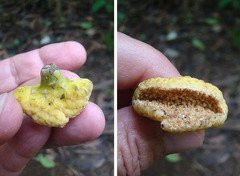
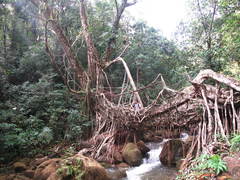
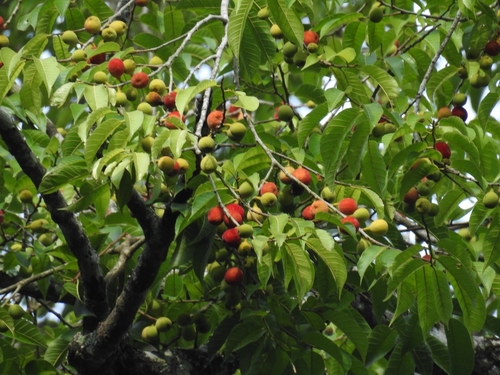
Antiaris is a genus in the mulberry and fig family Moraceae. It is a monotypic genus, containing only one species, Antiaris toxicaria. The genus was at one time considered to consist of several species, but is now regarded as just one variable species which can be further divided into five subspecies. One significant difference within the species is that the size of the fruit decreases as one travels from Africa to Polynesia. Antiaris has a remarkably wide distribution in tropical regions, occurring in Australia, tropical Asia, tropical Africa, Indonesia, the Philippines, Tonga, and various other tropical islands. Its seeds are spread by various birds and bats, and it is not clear how many of the populations are essentially invasive. The species is of interest as a source of wood, bark cloth, and pharmacological or toxic substances.
Read more on Wikipedia · Text: Wikipedia, CC BY-SA 4.0
El upas o pohon upas de las Molucas (Antiaris toxicaria) es un árbol de la familia de las moráceas, nativo del sudeste asiático. En la isla de Java, donde abunda, se lo conoce como "upas", por la palabra nativa para designar el veneno, siendo su látex utilizado como para envenenar flechas.
Seguir leyendo en Wikipedia · Texto: Wikipedia, CC BY-SA 4.0
见血封喉树(学名:Antiaris toxicaria),又称箭毒木或毒箭木,为木本植物桑科见血封喉属植物,是世界上最毒的植物之一。
箭毒木是见血封喉属下唯一种,但有不同亚种,生长在亚洲和非洲的热带地区,都含有剧毒的乳汁。中国只有见血封喉一种,见于云南的西双版纳、广西南部、广东西部和海南省等地,现已列为二级珍贵保护植物。
在维基百科上阅读更多 · 文字:维基百科,CC BY-SA 4.0
Classification
| Kingdom | Plantae |
|---|---|
| Phylum | Tracheophyta |
| Class | Magnoliopsida |
| Order | Rosales |
| Family | Moraceae |
| Genus | Antiaris |
In Suriname
Where it has been recorded
- Paramaribo3
Districts with at least one record that has coordinates. Shaded districts have records.