White-signed Morphet
Antirrhea philoctetes (Linnaeus, 1758)
Names
| English | White-signed Morphet |
|---|---|
| Dutch | — |
| Spanish | — |
| Chinese | — |
| Sranan Tongo | kapelka (general name for the group) |
| Scientific name | Antirrhea philoctetes (Linnaeus, 1758) |
About this species
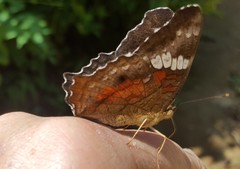
Antirrhea philoctetes, the common brown morpho, is a butterfly of the family Nymphalidae. It was described by Carl Linnaeus in 1758. It is found in Costa Rica, Panama, Guatemala, Colombia, Venezuela, the Guianas, Peru, Brazil and Bolivia. Antirrhea philoctetes is a large butterfly with a wingspan of approximately 95 mm to 105 mm. Its forewings have a concave outer margin, and its hindwings form three points at n3, n4, and n5 . The upperside is brown. The forewings are barred with white dots extending from the outer third of the costal margin to the inner margin. The hindwings are adorned with a postdiscal line of oval blue spots forming a band.The reverse is brown with a white line in the postdiscal area; it widens on the hindwing at n6 and contains a brown to black ocelli.
The larvae feed on Geonoma longivaginata.
Read more on Wikipedia · Text: Wikipedia, CC BY-SA 4.0
Antirrhea philoctetes is een vlinder uit de familie Nymphalidae. De wetenschappelijke naam van de soort is gepubliceerd in 1758 door Carl Linnaeus in de tiende editie van Systema naturae.
Lees verder op Wikipedia · Tekst: Wikipedia, CC BY-SA 4.0
Classification
| Kingdom | Animalia |
|---|---|
| Phylum | Arthropoda |
| Class | Insecta |
| Order | Lepidoptera |
| Family | Nymphalidae |
| Genus | Antirrhea |