Zebra Longwing
Heliconius charithonia (Linnaeus, 1767)
Names
| English | Zebra Longwing |
|---|---|
| Dutch | Zebravlinder |
| Spanish | Mariposa cebra |
| Chinese | 黄条袖蝶 |
| Sranan Tongo | kapelka (general name for the group) |
| Scientific name | Heliconius charithonia (Linnaeus, 1767) |
About this species
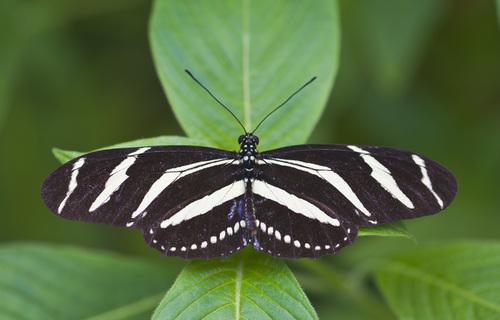
Heliconius charithonia, the zebra longwing or zebra heliconian, is a species of butterfly belonging to the subfamily Heliconiinae of the family Nymphalidae. It was first described by Carl Linnaeus in his 1767 12th edition of Systema Naturae. The boldly striped black and white wing pattern is aposematic, warning off predators. It is the state butterfly of Florida.
The species is distributed across South and Central America and as far north as southern Texas and peninsular Florida; there are migrations north into other American states in the warmer months.
Zebra longwing adults roost communally at night in groups of up to 60 adults for safety from predators. The adult butterflies are unusual in feeding on pollen as well as on nectar; the pollen enables them to synthesize cyanogenic glycosides that make their bodies toxic to potential predators. Caterpillars feed on various species of passionflower, evading the plants' defensive trichomes by biting them off or laying silk mats over them.
Read more on Wikipedia · Text: Wikipedia, CC BY-SA 4.0
La mariposa cebra (Heliconius charithonia) es una especie de mariposa perteneciente a la familia Nymphalidae. Fue declarada la mariposa oficial del estado de Florida en 1996.
Seguir leyendo en Wikipedia · Texto: Wikipedia, CC BY-SA 4.0
Classification
| Kingdom | Animalia |
|---|---|
| Phylum | Arthropoda |
| Class | Insecta |
| Order | Lepidoptera |
| Family | Nymphalidae |
| Genus | Heliconius |